Cross-posted at DailyKos
I haven't totally made up my mind on who I will support in the Democratic Primary, but at this point I'm leaning heavily toward John Edwards. My reasons are numerous, but they revolve around 2 overarching ideas: 1) his policies are specific and lead the country in a direction that I would like to see and 2) he's been in a presidential campaign before, and he's fought through all the way to election day, meaning that he would know the mistakes of Kerry/Edwards from '04 and has learned them. Add to this 2nd reason the fact that he's already been through the ringer the first time, so there isn't much that the GOP can throw at him that isn't either old hat or something he can easily refute...which brings us to the point of my post. The main argument against Edwards goes something like this: "He talks a good game on poverty but he gets expensive haircuts and makes a lot of money; ergo, he's a hyprocrite." The media, rather than focusing on his issues, has decided that his appearance and bank account are more important things to discuss. Let's go through the main three charges:
1) he got $400 haircuts
Yeah, so? Edwards' explanation is plausible. He's a popular guy who has to travel a lot and speak to many different places. They don't have time for him to go to his hometown barber, and they have someone cut his hair at hotels. The hairdresser people overcharged him, and he said himself that the fee is outrageous. Who hasn't gotten a bill for something and realized that they got overcharged?
2) he worked at a hedge fund and made money
Again, so? I'm not concerned about the $400,000+ that he made there because, as I will discuss below, he gave most of his earnings to charity. I'm not impressed by his "I took the job to learn about how markets work" excuse, but ultimately I'm not concerned. This is because he has not changed his stance on the taxation of such hedge funds. It would ONLY be hypocritical if he said that these organizations should still at as tax shelters and enjoy loopholes. He doesn't. Not hypocritical. Some tension maybe, but ultimately not enough to undercut credibility. Besides, I'll happily stack his few months of consulting work with a hedge fund against years of work fighting poverty both as an attorney and as the founder of UNC's poverty center. This objection does not give any credence to the idea that Edwards is hypocritical or doesn't really care about poverty.
3) he got $55,000 for a speech about poverty
This one has the potential to do the most superficial damage, not because of the facts of the case but more because of the way that the right-wing can spin it. In doing so, though, the right exposes its own stupidity and inability to make basic logical connections. In the link above, Carla Marinucci examines every speaking fee that John Edwards charged and found this one to be the most expensive one. The irony of asking for money to give a speech about poverty notwithstanding, the message here is that Edwards is hypocritical for taking money when he says that we should work to alleviate poverty in this country. Of course, FOX Noise Channel has picked up the story and run with it as ammunition for non-stop Edwards attacks, As News Hounds notes, quite well I might add, this just is not hypocrisy. I'll quote them: "If Edwards was going around advocating in favor of poverty, saying we should all strive for it and live simple, non-material lives as he lived the good life, THEN he would be a hypocrite. But what he does is advocate success and tries to show people how to achieve it, as he did." Even a junior varsity high school debater could see that. Edwards wants to fight to alleviate poverty, and his willingness to (cue dramatic music) get paid for working does not make him a hypocrite. It makes him human, like all of us.
Ultimately, these attacks are inconsequential for three main reasons.
1) Attackers focusing on how much money Edwards has made ignores how much money other candidates have made. This is particularly true if you look at the fact that Rudy Giuliani has made $9 million in speaking fees last year, charging over $100,000 per speech and even asking for a $47,000 private jet ride for one speaking engagement. Focus on Edwards' income is more hypocritical if you don't scrutinize that of other candidates.
2) Focus on how much Edwards has made is pointless if you fail to see that he gave almost $700,000 of his earnings to charity last year, including every cent he made from his book. That means even if you take all the money that he made from the hedge fund and speeches, he gave a majority of his earnings to charity last year. I'd say that works in his favor at least as much as (if not more than) the other things that the news media believe cut against him.
3) Finally, there is a more basic logical flaw here: that you have to be poor to care about or fight poverty. This is the most ridiculous of all the assumptions that people make. Edwards has used his position as a wealthy individual (who worked his way up from poverty and, as he's said himself, hasn't forgotten where he came from) to help those who need more help. In fact, he's in a better position to work to fight poverty if he has the resources to devote to it than he would be if he didn't have them. Being rich does not inherently mean that you don't care about poverty. Would we not believe Robert Kennedy for wanting to make poverty an issue in his Presidential campaign because he was a Kennedy? Of course not. It's ludicrous to think that Robert Kennedy didn't care about poor people because of his wealthy family.
Judge Edwards by his issues and how his actions actually effect them rather than trying to create a link between the two that is tenuous at best.
Wednesday, May 23, 2007


Friday, May 18, 2007
Great article on the Paul vs. Giuliani
Roland Martin, radio talk show host and occasional CNN commentator has a great comment on the surreal back-and-forth between Rep. Ron Paul and Rudy Giuliani over the impetus for 9/11 in the 2nd Republican debate. Basically, the gist of the article is that, despite the "Rudy sure showed him" attitude that most have taken toward the exchange, we should be willing to consider what Paul said. Doing so doesn't mean that we love terrorists or we hate America. It actually shows a maturity that we need as a country. It's below.
______________________
Martin: Paul's 9/11 explanation deserves to be debated
POSTED: 9:26 p.m. EDT, May 18, 2007
By Roland S. Martin
CNN contributor
(CNN) -- Former New York Mayor Rudy Giuliani was declared the winner of Tuesday's Republican presidential debate in South Carolina, largely for his smack down of Texas Rep. Ron Paul, who suggested that America's foreign policy contributed to the destruction on September 11, 2001.
Paul, who is more of a libertarian than a Republican, was trying to offer some perspective on the pitfalls of an interventionist policy by the American government in the affairs of the Middle East and other countries.
"Have you ever read about the reasons they attacked us? They attack us because we've been over there. We've been bombing Iraq for 10 years," he said.
That set Giuliani off.
"That's really an extraordinary statement," said Giuliani. "As someone who lived through the attack of September 11, that we invited the attack because we were attacking Iraq; I don't think I've ever heard that before and I've heard some pretty absurd explanations for September 11."
As the crowd applauded wildly, Giuliani demanded that Paul retract his statements.
Paul tried to explain the process known as "blowback" -- which is the result of someone else's action coming back to afflict you -- but the audience drowned him out as the other candidates tried to pounce on him.
After watching all the network pundits laud Giuliani, it struck me that they must be the most clueless folks in the world.
First, Giuliani must be an idiot to not have heard Paul's rationale before. That issue has been raised countless times in the last six years by any number of experts.
Second, when we finish with our emotional response, it would behoove us to actually think about what Paul said and make the effort to understand his rationale.
Granted, Americans were severely damaged by the hijacking of U.S. planes, and it has resulted in a worldwide fight against terror. Was it proper for the United States to respond to the attack? Of course! But should we, as a matter of policy, and moral decency, learn to think and comprehend that our actions in one part of the world could very well come back to hurt us, or, as Paul would say, blow back in our face? Absolutely. His real problem wasn't his analysis, but how it came out of his mouth.
What has been overlooked is that Paul based his position on the effects of the 1953 ouster by the CIA of Iranian Prime Minister Mohammad Mossadegh.
An excellent account of this story is revealed in Stephen Kinzer's alarming and revealing book, "Overthrow: America's Century of Regime Change from Hawaii to Iraq," where he writes that Iran was establishing a government close to a democracy. But Mossadegh wasn't happy that the profit from the country's primary resource -- oil -- was not staying in the country.
Instead, the Anglo-Iranian Oil Company (now known British Petroleum, or BP) was getting 93 percent of the profits. Mossadegh didn't like that, and wanted a 50-50 split. Kinzer writes that that didn't sit too well with the British government, but it didn't want to use force to protect its interests. But their biggest friend, the United States, didn't mind, and sought to undermine Mossadegh's tenure as president. After all kinds of measures that disrupted the nation, a coup was financed and led by President Dwight Eisenhower's CIA, and the Shah of Iran was installed as the leader. We trained his goon squads, thus angering generations of Iranians for meddling in that nation's affairs.
As Paul noted, what happened in 1953 had a direct relationship to the takeover of the U.S. Embassy in 1979. We viewed that as terrorists who dared attack America. They saw it as ending years of oppression at the hands of the ruthless U.S.-backed Shah regime.
As Americans, we believe in forgiving and forgetting, and are terrible at understanding how history affects us today. We are arrogant in not recognizing that when we benefit, someone else may suffer. That will lead to resentment and anger, and if suppressed, will boil over one day.
Does that provide a moral justification for what the terrorists did on September 11?
Of course not. But we should at least attempt to understand why.
Think about it. Do we have the moral justification to explain the killings of more than 100,000 Iraqis as a result of this war? Can we defend the efforts to overthrow other governments whose actions we perceived would jeopardize American business interests?
The debate format didn't give Paul the time to explain all of this. But I'm confident this is what he was saying. And yes, we need to understand history and how it plays a vital role in determining matters today.
At some point we have to accept the reality that playing big brother to the world -- and yes, sometimes acting as a bully by wrongly asserting our military might -- means that Americans alive at the time may not feel the effects of our foreign policy, but their innocent children will.
Even the Bible says that the children will pay for the sins of their fathers.
______________________
Martin: Paul's 9/11 explanation deserves to be debated
POSTED: 9:26 p.m. EDT, May 18, 2007
By Roland S. Martin
CNN contributor
(CNN) -- Former New York Mayor Rudy Giuliani was declared the winner of Tuesday's Republican presidential debate in South Carolina, largely for his smack down of Texas Rep. Ron Paul, who suggested that America's foreign policy contributed to the destruction on September 11, 2001.
Paul, who is more of a libertarian than a Republican, was trying to offer some perspective on the pitfalls of an interventionist policy by the American government in the affairs of the Middle East and other countries.
"Have you ever read about the reasons they attacked us? They attack us because we've been over there. We've been bombing Iraq for 10 years," he said.
That set Giuliani off.
"That's really an extraordinary statement," said Giuliani. "As someone who lived through the attack of September 11, that we invited the attack because we were attacking Iraq; I don't think I've ever heard that before and I've heard some pretty absurd explanations for September 11."
As the crowd applauded wildly, Giuliani demanded that Paul retract his statements.
Paul tried to explain the process known as "blowback" -- which is the result of someone else's action coming back to afflict you -- but the audience drowned him out as the other candidates tried to pounce on him.
After watching all the network pundits laud Giuliani, it struck me that they must be the most clueless folks in the world.
First, Giuliani must be an idiot to not have heard Paul's rationale before. That issue has been raised countless times in the last six years by any number of experts.
Second, when we finish with our emotional response, it would behoove us to actually think about what Paul said and make the effort to understand his rationale.
Granted, Americans were severely damaged by the hijacking of U.S. planes, and it has resulted in a worldwide fight against terror. Was it proper for the United States to respond to the attack? Of course! But should we, as a matter of policy, and moral decency, learn to think and comprehend that our actions in one part of the world could very well come back to hurt us, or, as Paul would say, blow back in our face? Absolutely. His real problem wasn't his analysis, but how it came out of his mouth.
What has been overlooked is that Paul based his position on the effects of the 1953 ouster by the CIA of Iranian Prime Minister Mohammad Mossadegh.
An excellent account of this story is revealed in Stephen Kinzer's alarming and revealing book, "Overthrow: America's Century of Regime Change from Hawaii to Iraq," where he writes that Iran was establishing a government close to a democracy. But Mossadegh wasn't happy that the profit from the country's primary resource -- oil -- was not staying in the country.
Instead, the Anglo-Iranian Oil Company (now known British Petroleum, or BP) was getting 93 percent of the profits. Mossadegh didn't like that, and wanted a 50-50 split. Kinzer writes that that didn't sit too well with the British government, but it didn't want to use force to protect its interests. But their biggest friend, the United States, didn't mind, and sought to undermine Mossadegh's tenure as president. After all kinds of measures that disrupted the nation, a coup was financed and led by President Dwight Eisenhower's CIA, and the Shah of Iran was installed as the leader. We trained his goon squads, thus angering generations of Iranians for meddling in that nation's affairs.
As Paul noted, what happened in 1953 had a direct relationship to the takeover of the U.S. Embassy in 1979. We viewed that as terrorists who dared attack America. They saw it as ending years of oppression at the hands of the ruthless U.S.-backed Shah regime.
As Americans, we believe in forgiving and forgetting, and are terrible at understanding how history affects us today. We are arrogant in not recognizing that when we benefit, someone else may suffer. That will lead to resentment and anger, and if suppressed, will boil over one day.
Does that provide a moral justification for what the terrorists did on September 11?
Of course not. But we should at least attempt to understand why.
Think about it. Do we have the moral justification to explain the killings of more than 100,000 Iraqis as a result of this war? Can we defend the efforts to overthrow other governments whose actions we perceived would jeopardize American business interests?
The debate format didn't give Paul the time to explain all of this. But I'm confident this is what he was saying. And yes, we need to understand history and how it plays a vital role in determining matters today.
At some point we have to accept the reality that playing big brother to the world -- and yes, sometimes acting as a bully by wrongly asserting our military might -- means that Americans alive at the time may not feel the effects of our foreign policy, but their innocent children will.
Even the Bible says that the children will pay for the sins of their fathers.
Thursday, October 05, 2006
Wednesday, September 20, 2006
Monday, September 18, 2006
Friday, July 21, 2006
Interesting Debates
I'm currently working with the Ben Franklin Transatlantic Fellows Initiative at Wake Forest University. We are recording podcast debates on several topics in world affairs, and I encourage you to listen to the debates and comment on them. My group is talking about the death of Shamil Basayev, discussing what possible effect that his death will have on Russia. Please take a little time to listen and comment on the discussion if you want to add something.
Thanks!
Thanks!
Wednesday, July 19, 2006
Sunday, July 09, 2006
Monday, June 05, 2006
ways to actually protect marriage
From Left in the West
If you want to do something that actually helps marriages, then
1. Raise the public’s consciousnesas of the dignity and importance of women in our still deeply patriarchal society.
2. Provide every couple with a guarantee of health insurance that spares them the relational strains inflicted by devastating illness and an inability to pay for medical care.
3. Increase the minimum wage and offer tax breaks to the working poor so that spouses can see each other for more quality length of time, rather than briefly passing eachother on their way to two jobs.
4. Cover mental healthcare in medical insurance policies so that serious emotional difficulties can be prevented from tearing marriages apart.
5. Encourage family planning.
6. Set aside resources for dealing with domestic abuse. Well, at least, that’s a start.
If you want to do something that actually helps marriages, then
1. Raise the public’s consciousnesas of the dignity and importance of women in our still deeply patriarchal society.
2. Provide every couple with a guarantee of health insurance that spares them the relational strains inflicted by devastating illness and an inability to pay for medical care.
3. Increase the minimum wage and offer tax breaks to the working poor so that spouses can see each other for more quality length of time, rather than briefly passing eachother on their way to two jobs.
4. Cover mental healthcare in medical insurance policies so that serious emotional difficulties can be prevented from tearing marriages apart.
5. Encourage family planning.
6. Set aside resources for dealing with domestic abuse. Well, at least, that’s a start.
Friday, June 02, 2006
A must read
Ever since Election Night '04 I've felt that something was amiss with the result, and now my hunch has been supported by factual evidence provided by people who actually did the research. The exit polls have stuck out in my mind, but it's good to see someone talk to statisticians who verified that they could not have been as far off as they were without manipulation. RFK provides a very well documented, compelling case for the argument that Kerry should be President of the USA right now. It's kinda depressing to read, but then mostly everything else is too, right?
Was the '04 Election stolen also?
Was the '04 Election stolen also?
Sunday, December 18, 2005
My main objection to Bush's speech
Now, I realize that many of the liberal bloggers will talk about the problems with Bush's speech tonight, and I will no doubt agree with many assessments. They will talk about how Bush was sticking to the "we must stay until victory" stuff despite the overwhelming evidence that his rosy vision of the country is just another example of his selective viewing of the facts. They'll also show many news reports that deny Bush's claims. One thing I suspect they do and will miss is one glaring part of the speech that jumped out of the TV screen at me. The following portion is from the full text of the speech available at ThinkProgress.
"The terrorists do not merely object to American actions in Iraq and elsewhere – they object to our deepest values and our way of life. And if we were not fighting them in Iraq … in Afghanistan … in Southeast Asia … and in other places, the terrorists would not be peaceful citizens – they would be on the offense, and headed our way.
September 11th, 2001 required us to take every emerging threat to our country seriously, and it shattered the illusion that terrorists attack us only after we provoke them. On that day, we were not in Iraq … we were not in Afghanistan … but the terrorists attacked us anyway – and killed nearly 3,000 men, women, and children in our own country. My conviction comes down to this: We do not create terrorism by fighting the terrorists. We invite terrorism by ignoring them. And we will defeat the terrorists by capturing and killing them abroad … removing their safe havens … and strengthening new allies like Iraq and Afghanistan in the fight we share."
Do you see that? Do you see how brazen of a baseline claim he made there? It's not just his claims about Iraq that are erroneous and misleading. His very claim about September 11th is the starting point for this entire mess. He says that "the terrorists" attacked the US on 9/11/01 without provocation. They just attacked us because they're so evil and they hate that we're so good. If we stopped all our military actions, they would still attack us because they're just evil...that's how they roll.
This view right here forgets all history that predates 9/11/01. It misses the obvious fact that 1) we WERE in Iraq before 9/11 and in fact did have a military presence flying over Iraq daily to enforce our arbitrary "no-fly zones" and 2) the US has done many things prior to 9/11 to make people angry enough to design, plan, and execute a highly coordinated activity such as the 9/11 attacks. I shouldn't need to list them, but here's a sample: Iraq (the first time around as well as our support for Saddam Hussein's brutality in the 80's while he was committing his worst crimes), our support for Israel and their violence against Muslims, our military presence in Saudi Arabia, our traning and monetary support for Osama bin Laden and the Mujahideen in Afghanistan (a group that Reagan referred to as "freedom fighters"), and the list goes on.
The attacks on 9/11 were horrible and completely unjustified, but they were NOT unprovoked. The "they started it" defense is not only factually incorrect, it paints us as the innocent superpower that is justified in ANY response it takes to violence. 9/11 wasn't justifiable, and neither was the US invasion of Iraq. Before we will ever hope to see the end of the so-called "war on terror," we must be willing to look in the mirror and see the fault of our previous actions. We must begin to make amends for what we've done and get our house in order. Only then can we begin to talk about (much less undertake) the task of stopping the spread of terrorism around the globe. Only a good faith effort on our part will begin to change the perception that people from other countries have of us.
That and unequivocably stopping anything that could even possibly resemble torture. Repeating the lie "we do not torture" is obviously not working for us. By the way, I'm not advocating that we stop torturing just because it hurts America's image around the world. I think that we should not torture simply because it's wrong. End of story. We should need NO other reason to stop it. The fact that we even have to ask whether our government engages in torture tells me that we've gone too far.
"The terrorists do not merely object to American actions in Iraq and elsewhere – they object to our deepest values and our way of life. And if we were not fighting them in Iraq … in Afghanistan … in Southeast Asia … and in other places, the terrorists would not be peaceful citizens – they would be on the offense, and headed our way.
September 11th, 2001 required us to take every emerging threat to our country seriously, and it shattered the illusion that terrorists attack us only after we provoke them. On that day, we were not in Iraq … we were not in Afghanistan … but the terrorists attacked us anyway – and killed nearly 3,000 men, women, and children in our own country. My conviction comes down to this: We do not create terrorism by fighting the terrorists. We invite terrorism by ignoring them. And we will defeat the terrorists by capturing and killing them abroad … removing their safe havens … and strengthening new allies like Iraq and Afghanistan in the fight we share."
Do you see that? Do you see how brazen of a baseline claim he made there? It's not just his claims about Iraq that are erroneous and misleading. His very claim about September 11th is the starting point for this entire mess. He says that "the terrorists" attacked the US on 9/11/01 without provocation. They just attacked us because they're so evil and they hate that we're so good. If we stopped all our military actions, they would still attack us because they're just evil...that's how they roll.
This view right here forgets all history that predates 9/11/01. It misses the obvious fact that 1) we WERE in Iraq before 9/11 and in fact did have a military presence flying over Iraq daily to enforce our arbitrary "no-fly zones" and 2) the US has done many things prior to 9/11 to make people angry enough to design, plan, and execute a highly coordinated activity such as the 9/11 attacks. I shouldn't need to list them, but here's a sample: Iraq (the first time around as well as our support for Saddam Hussein's brutality in the 80's while he was committing his worst crimes), our support for Israel and their violence against Muslims, our military presence in Saudi Arabia, our traning and monetary support for Osama bin Laden and the Mujahideen in Afghanistan (a group that Reagan referred to as "freedom fighters"), and the list goes on.
The attacks on 9/11 were horrible and completely unjustified, but they were NOT unprovoked. The "they started it" defense is not only factually incorrect, it paints us as the innocent superpower that is justified in ANY response it takes to violence. 9/11 wasn't justifiable, and neither was the US invasion of Iraq. Before we will ever hope to see the end of the so-called "war on terror," we must be willing to look in the mirror and see the fault of our previous actions. We must begin to make amends for what we've done and get our house in order. Only then can we begin to talk about (much less undertake) the task of stopping the spread of terrorism around the globe. Only a good faith effort on our part will begin to change the perception that people from other countries have of us.
That and unequivocably stopping anything that could even possibly resemble torture. Repeating the lie "we do not torture" is obviously not working for us. By the way, I'm not advocating that we stop torturing just because it hurts America's image around the world. I think that we should not torture simply because it's wrong. End of story. We should need NO other reason to stop it. The fact that we even have to ask whether our government engages in torture tells me that we've gone too far.
Saturday, December 17, 2005
Meet the new COINTELPRO, same as the old COINTELPRO
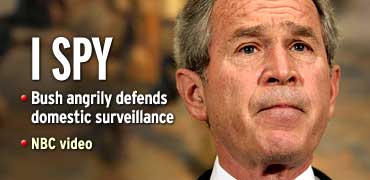
MSNBC's website headline today was pretty funny .
Seriously though, Bush's defense of his decision to allow the NSA to spy on Americans whenever they want without having to obtain a court order reminded me of the pivotal scene in A Few Good Men where Tom Cruise is examining Jack Nicholson. Nicholson's response is very similar to Bush's defense today: yeah, I did it and I'd do it again...you know you want me to keep doing it. It's the defense of a person so blinded by his/her view of the world the s/he can't see the damage that view has. I have the dialogue from the movie below...I couldn't help but feel some real similarities with the radio address today.
from http://www.whysanity.net/monos/fewgood.html
Jessep: You want answers?
Kaffee (Tom Cruise): I think I'm entitled to them.
Jessep: You want answers?
Kaffee: I want the truth!
Jessep: You can't handle the truth! Son, we live in a world that has walls. And those walls have to be guarded by men with guns. Who's gonna do it? You? You, Lt. Weinberg? I have a greater responsibility than you can possibly fathom. You weep for Santiago and you curse the Marines. You have that luxury. You have the luxury of not knowing what I know: that Santiago's death, while tragic, probably saved lives. And my existence, while grotesque and incomprehensible to you, saves lives...You don't want the truth. Because deep down, in places you don't talk about at parties, you want me on that wall. You need me on that wall.We use words like honor, code, loyalty...we use these words as the backbone to a life spent defending something. You use 'em as a punchline. I have neither the time nor the inclination to explain myself to a man who rises and sleeps under the blanket of the very freedom I provide, then questions the manner in which I provide it! I'd rather you just said thank you and went on your way. Otherwise, I suggest you pick up a weapon and stand a post. Either way, I don't give a damn what you think you're entitled to!
Kaffee: Did you order the code red?
Jessep: (quietly) I did the job you sent me to do.
Kaffee: Did you order the code red?
Jessep: You're goddamn right I did!!
Saturday, December 10, 2005
I miss Paul Wellstone
Over the past coupla days, I was working on a paper on Paul Wellstone's ads in his 1990 Senate campaign. After reading parts from Wellstone's book and his ad guy's book, I really miss Wellstone. It's a shame that there aren't more people like him in government.
Tuesday, July 19, 2005
More on Rove
This evening, Bush will finally have a distraction from the media whirlwind surrounding Karl Rove's improper (and possibly illegal) actions when he announces his nominee for the Supreme Court. All eyes will be on this, so it may take some attention away from Rove. Let's hope not, though. I'm sure that for Bush, the more contentious the nominee, the more attention it takes away from Rove. It's time to see if the media has the ability to focus on two things at the same time. If they don't, the good news is that (as Kos has said) the special prosecutor will not let the Supreme Court nominee distract him from his business.
One thing I wanted to mention about Bush's slight of hand with regards to whether someone will be fired in his Administration. In case you've been living under a rock the past couple days, Bush said, "if someone committed a crime, they will no longer work in my administration." Now many have seen this for what it obviously is, a shameless ploy to wiggle out of Bush's previous statements that anyone involved (in any way) would be fired. I totally agree, he's changing the standard for what it'll take to fire somebody so he doesn't lose Rove. What's interesting, though, is that I just read the cover story of Time's most recent issue (not what Cooper wrote, the other story). It seemed to suggest, based on information from an anonymous source involved with the investigation, that the special prosecutor isn't just focusing on the Intelligence Identities Protection Act. The special prosecutor might also be looking into other crimes, such as perjury or obstruction of justice. This fact might cause Bush's sneaky remarks to come right back and bite him in the ass. If Rove is indicted or convicted of perjury, that's a crime. Bush didn't say how serious the crime has to be, just that if someone committed a crime they would be fired. I would love to see the Bushies try to wiggle themselves out of this one! Either Bush would have to lose Rove, or this becomes the most blatent lie that he has directly told the American people.
One thing I wanted to mention about Bush's slight of hand with regards to whether someone will be fired in his Administration. In case you've been living under a rock the past couple days, Bush said, "if someone committed a crime, they will no longer work in my administration." Now many have seen this for what it obviously is, a shameless ploy to wiggle out of Bush's previous statements that anyone involved (in any way) would be fired. I totally agree, he's changing the standard for what it'll take to fire somebody so he doesn't lose Rove. What's interesting, though, is that I just read the cover story of Time's most recent issue (not what Cooper wrote, the other story). It seemed to suggest, based on information from an anonymous source involved with the investigation, that the special prosecutor isn't just focusing on the Intelligence Identities Protection Act. The special prosecutor might also be looking into other crimes, such as perjury or obstruction of justice. This fact might cause Bush's sneaky remarks to come right back and bite him in the ass. If Rove is indicted or convicted of perjury, that's a crime. Bush didn't say how serious the crime has to be, just that if someone committed a crime they would be fired. I would love to see the Bushies try to wiggle themselves out of this one! Either Bush would have to lose Rove, or this becomes the most blatent lie that he has directly told the American people.
Saturday, July 16, 2005
a Rove-an rant
I've become quite amused with the Karl Rove story because it's fun to see the media taking this one seriously for once. It used to be that something comes out about the Bush administration's shadiness, they deny it, and the media lets it go after a day or so. The media is actually following up on it for a couple days. I like that the stonewalling is only piquing the media's interest. It's fun to watch the White House press briefings from the past 3 days. The media is getting frustrated, and they're firing back for once. I don't know if they'll have the stamina to keep this up for a few weeks, but I hope they do.
David Corn has some interesting analysis on this whole debacle. One of his best questions is as follows: "Is it better or worse for the Dems to make a big stink? It does keep the story going. But it has given all the right-wing spinners the opportunity to create a new framework for the story: this is just a partisan smear attack." It's true that the Republicans like to lean on this one as their standard response when Democrats go on the attack, no matter what it the attack is about. I think, however, that the Democrats have a couple good responses to this dilemma. First, some Democrats (John Kerry, Howard Dean, etc.) have made sure to point out that this issue rises above partisan bickering. It goes to the very credibility of the White House. Even if Rove didn't technically break any laws, he acted in a way that tarnishes (even further) the office of the President. That alone deserves a regination or a pink slip. Second, as Tim Russert (of all people) noted a couple days ago on the Today Show, "If this was a Democratic White House, we'd have Congressional hearings in a Second." This response is significant because it highlights the fact that the Republicans' unwillingness to do something about Rove is itself playing politics! The Republicans are doing everything to help their people, and it's making them look bad.
The Republicans have released talking points (scroll down the page for a copy of the talking points) to deflect criticism from Rove to Wilson. They're trying to attack Wilson for being partisan because he found out that documents were forged to drum up support for the invasion of Iraq. These attacks are clearly beside the point. They amount to defending Rove's unethical and potentially illegal action. It's sad. First of all, the Republicans are lying (right now Al Franken is debunking the talking points on his radio show) and taking quotations out of context for their attacks. Second, they are defending potentially criminal activity!
I'm curious about George W. Bush's role in this. There needs to be some accountability in the White House. Now, I know that Dubya isn't great on taking responsibility for mistakes and wrongdoings (recall that Dubya himself could not come up with a single mistake he has ever made aside from trading Sammy Sosa and appointing some people), as many of us on the left know very well, but he clearly said he would take action if someone was found out leaking classified info. Check out David Corn's analysis (link above) that shows Rove did leak classified info. George has said that he is a straight shooter whose word is his bond. He needs to fire Rove, and if he doesn't, Bush himself should be removed from office for his unwillingness to take responsibility or hold those reponsible accountable. Also, what did Bush know about this leak, and when did he know it? If Bush knew what Rove was doing when Rove did it, then Bush would be culpable in this matter as well!! This is the type of questioning the media needs to follow up on. It's not like this was a low-level person who did a leak under the nose of the higher ups in the administration. This is Bush's top advisor!! He's known Rove for almost 20 years! He's gotta know what Rove did, and if he isn't willing to do something about it, then Bush himself should go.
Overall, the media from all over should rachet up the pressure on the White House here. This means talk about it w/ everyone and demand that Karl Rove leave. Now, I expect that even if more and more pressure comes to fire Rove, Bush won't do it. He's got too much invested in Rove to let him go. Besides, it's not like incompetence or wrongdoing have been compelling enough to cause Bush to fire anybody. He values loyalty over competence. History proves this to be true. Alberto Gonzales (torture), Donald Rumsfeld (not enough troop support and lying about wmd), and Condi Rice (ignored "bin laden determined to attack US" memo) have screwed things up during the first 4 years, and they have either kept their job or been promoted to another position. Paul Bremer and George Tenet messed up the war and reconstruction in Iraq, and they got medals of freedom. I expect the same kind of response to Karl Rove. He'll be kept on, and it'll only make them look worse. Goodie gumdrops.
David Corn has some interesting analysis on this whole debacle. One of his best questions is as follows: "Is it better or worse for the Dems to make a big stink? It does keep the story going. But it has given all the right-wing spinners the opportunity to create a new framework for the story: this is just a partisan smear attack." It's true that the Republicans like to lean on this one as their standard response when Democrats go on the attack, no matter what it the attack is about. I think, however, that the Democrats have a couple good responses to this dilemma. First, some Democrats (John Kerry, Howard Dean, etc.) have made sure to point out that this issue rises above partisan bickering. It goes to the very credibility of the White House. Even if Rove didn't technically break any laws, he acted in a way that tarnishes (even further) the office of the President. That alone deserves a regination or a pink slip. Second, as Tim Russert (of all people) noted a couple days ago on the Today Show, "If this was a Democratic White House, we'd have Congressional hearings in a Second." This response is significant because it highlights the fact that the Republicans' unwillingness to do something about Rove is itself playing politics! The Republicans are doing everything to help their people, and it's making them look bad.
The Republicans have released talking points (scroll down the page for a copy of the talking points) to deflect criticism from Rove to Wilson. They're trying to attack Wilson for being partisan because he found out that documents were forged to drum up support for the invasion of Iraq. These attacks are clearly beside the point. They amount to defending Rove's unethical and potentially illegal action. It's sad. First of all, the Republicans are lying (right now Al Franken is debunking the talking points on his radio show) and taking quotations out of context for their attacks. Second, they are defending potentially criminal activity!
I'm curious about George W. Bush's role in this. There needs to be some accountability in the White House. Now, I know that Dubya isn't great on taking responsibility for mistakes and wrongdoings (recall that Dubya himself could not come up with a single mistake he has ever made aside from trading Sammy Sosa and appointing some people), as many of us on the left know very well, but he clearly said he would take action if someone was found out leaking classified info. Check out David Corn's analysis (link above) that shows Rove did leak classified info. George has said that he is a straight shooter whose word is his bond. He needs to fire Rove, and if he doesn't, Bush himself should be removed from office for his unwillingness to take responsibility or hold those reponsible accountable. Also, what did Bush know about this leak, and when did he know it? If Bush knew what Rove was doing when Rove did it, then Bush would be culpable in this matter as well!! This is the type of questioning the media needs to follow up on. It's not like this was a low-level person who did a leak under the nose of the higher ups in the administration. This is Bush's top advisor!! He's known Rove for almost 20 years! He's gotta know what Rove did, and if he isn't willing to do something about it, then Bush himself should go.
Overall, the media from all over should rachet up the pressure on the White House here. This means talk about it w/ everyone and demand that Karl Rove leave. Now, I expect that even if more and more pressure comes to fire Rove, Bush won't do it. He's got too much invested in Rove to let him go. Besides, it's not like incompetence or wrongdoing have been compelling enough to cause Bush to fire anybody. He values loyalty over competence. History proves this to be true. Alberto Gonzales (torture), Donald Rumsfeld (not enough troop support and lying about wmd), and Condi Rice (ignored "bin laden determined to attack US" memo) have screwed things up during the first 4 years, and they have either kept their job or been promoted to another position. Paul Bremer and George Tenet messed up the war and reconstruction in Iraq, and they got medals of freedom. I expect the same kind of response to Karl Rove. He'll be kept on, and it'll only make them look worse. Goodie gumdrops.
Sunday, June 26, 2005
the meaning of "moral values" or, what would Freud say about Republicans?
I'm sure a lot of us have heard about the statistic that a large chunk of voters who voted for Bush last November voted because of "moral values." I also happen to have heard a number of people on the radical right (including a grad school classmate who shall remain nameless) talk about the need to connect morality to the common voter more extensively than is already being done. You hear it mostly from voices of the religious radical right. They say that we need to get back to moral values because the country is in a moral decline (blah blah blah). This is a very clever discursive trick (for which I'm sure Karl Rove is at least partly to blame) played on the American people. "Moral values" as defined by the radical right doesn't really mean adhering to an ethical standard in all one's actions (be they public or private). It is code for a narrowly defined ideology that divides the world into "us" and "them" for the purposes of passing a specific set of policies that increase governmental power over the individual.
For starters, when the radical right-wing in the United States refers to "morality" or "moral values," they are really only talking about one thing: sex. Think about it, what did Republicans spend most of their time demonizing in Clinton? Monica. Of course there were other things, but the main thing that Republicans spent their time on was Clinton's zipper problem. Almost all of what the radical right considers to be moral issues are merely variations on an attempt to control sexual activity, which is (to some extent) a private matter that should not be the business of the government. Obviously, there is some sexual activity that should be regulated (rape, sexual abuse against children, anything that isn't consentual), but consentual sexual activity between adults is no business of the government, despite the radical right's attempts. Let's go issue by issue. First, Republicans want to eradicate homosexuality from the face of the earth, starting with a Constitutional Amendment to prevent gay, lesbian, bisexual, and transgendered persons from enterring into holy matrimony. It should be obvious that this is an attempt to regulate with whom one may have sex. The radical right ardently pushes "abstinence only" sex education in schools (despite studies that now show that they are counterproductive). They do this while demonizing condom use. This is an attempt to regulate where and when one may have sex. The radical right is dead set on cutting welfare and social programs for poor single mothers. This sounds like punishment for what they would consider promiscuous sexuality (because, as the logic goes, if they would only get a man and marry then they wouldn't be in such dire straits to begin with). Then, of course, there's the radical right's staunch opposition to abortion (despite its tension not only with their position on condoms but also their economic policies). This is an attempt to regulate the consequences of one's "deviant" sexual activity. Oh, and don't forget the right's feigned indignation over the brief exposure of Janet Jackson's breast at the Super Bowl in '04. It would appear that, to paraphrase my dad, "their Freudian slip is showing."
My problem with the radical right's characterization of "moral values" is not just that it betrays a very repressed sexuality that needs serious attention. My main objection is that they focus on sexuality as morality at the expense of other, more pressing moral issues. Many other aspects of our life deal with morality that the religious radical right will not touch. Here I am more than happy to give examples. Poverty is a moral issue (hunger also goes with this). In fact, in comparison to the few verses in the Bible that mention homosexuality (no more than 10 at the most), there are literally thousands of verses in the Bible that talk about the need to fight poverty, both individually and institutionally. Lying is a moral issue, so lying about why American troops need to go to Iraq and die is just as immoral as any of the sexual sins the radical right preaches about ad nauseum. Stealing from people is morally wrong, so CEOs from such companies as Enron and Tyco are wrong. There's even the famous story in the Bible of the tax collector Jesus meets, and that tax collector realizes that he was wrong for stealing from people and gives the money back. Such thievery should be a big deal in our society, but we just shrug and don't get outraged like we would if someone sees two men kissing. Health care is also a moral issue. Did you know that? Jesus says we must care for the "least of these." Not only is that part of the concern for poverty, but it is also for health care. I am convinced that it is of moral concern that we do not have universal health care coverage. I'm sure people can debate about specifics of this coverage until they're blue in the face, but the fact is that it is evidence of our moral failing that we are not concerned about someone else getting sick without the ability to go to a doctor. If we are truly to love one another, shouldn't we agree that we all deserve health care?
The radical right wants to use the power of the government to regulate behavior that is between the individual and God. It is not their place to judge. Jesus also had something to say about this. If we want to talk about morality on a political/social level, fine. It has to include, however, issues that are actually social in nature. How we treat each other is a moral issue. Issues like poverty, hunger, corporate thievery, health care, and others like it are issues of morality. The radical right dismisses these moral issues at their own peril. Many people seem to think that leftist beliefs are inherently in opposition to Christian teachings. Nothing could be further from the truth. I gain my leftist leanings directly from the teachings of Jesus Christ. It's not my fault that Jesus is a liberal.
For starters, when the radical right-wing in the United States refers to "morality" or "moral values," they are really only talking about one thing: sex. Think about it, what did Republicans spend most of their time demonizing in Clinton? Monica. Of course there were other things, but the main thing that Republicans spent their time on was Clinton's zipper problem. Almost all of what the radical right considers to be moral issues are merely variations on an attempt to control sexual activity, which is (to some extent) a private matter that should not be the business of the government. Obviously, there is some sexual activity that should be regulated (rape, sexual abuse against children, anything that isn't consentual), but consentual sexual activity between adults is no business of the government, despite the radical right's attempts. Let's go issue by issue. First, Republicans want to eradicate homosexuality from the face of the earth, starting with a Constitutional Amendment to prevent gay, lesbian, bisexual, and transgendered persons from enterring into holy matrimony. It should be obvious that this is an attempt to regulate with whom one may have sex. The radical right ardently pushes "abstinence only" sex education in schools (despite studies that now show that they are counterproductive). They do this while demonizing condom use. This is an attempt to regulate where and when one may have sex. The radical right is dead set on cutting welfare and social programs for poor single mothers. This sounds like punishment for what they would consider promiscuous sexuality (because, as the logic goes, if they would only get a man and marry then they wouldn't be in such dire straits to begin with). Then, of course, there's the radical right's staunch opposition to abortion (despite its tension not only with their position on condoms but also their economic policies). This is an attempt to regulate the consequences of one's "deviant" sexual activity. Oh, and don't forget the right's feigned indignation over the brief exposure of Janet Jackson's breast at the Super Bowl in '04. It would appear that, to paraphrase my dad, "their Freudian slip is showing."
My problem with the radical right's characterization of "moral values" is not just that it betrays a very repressed sexuality that needs serious attention. My main objection is that they focus on sexuality as morality at the expense of other, more pressing moral issues. Many other aspects of our life deal with morality that the religious radical right will not touch. Here I am more than happy to give examples. Poverty is a moral issue (hunger also goes with this). In fact, in comparison to the few verses in the Bible that mention homosexuality (no more than 10 at the most), there are literally thousands of verses in the Bible that talk about the need to fight poverty, both individually and institutionally. Lying is a moral issue, so lying about why American troops need to go to Iraq and die is just as immoral as any of the sexual sins the radical right preaches about ad nauseum. Stealing from people is morally wrong, so CEOs from such companies as Enron and Tyco are wrong. There's even the famous story in the Bible of the tax collector Jesus meets, and that tax collector realizes that he was wrong for stealing from people and gives the money back. Such thievery should be a big deal in our society, but we just shrug and don't get outraged like we would if someone sees two men kissing. Health care is also a moral issue. Did you know that? Jesus says we must care for the "least of these." Not only is that part of the concern for poverty, but it is also for health care. I am convinced that it is of moral concern that we do not have universal health care coverage. I'm sure people can debate about specifics of this coverage until they're blue in the face, but the fact is that it is evidence of our moral failing that we are not concerned about someone else getting sick without the ability to go to a doctor. If we are truly to love one another, shouldn't we agree that we all deserve health care?
The radical right wants to use the power of the government to regulate behavior that is between the individual and God. It is not their place to judge. Jesus also had something to say about this. If we want to talk about morality on a political/social level, fine. It has to include, however, issues that are actually social in nature. How we treat each other is a moral issue. Issues like poverty, hunger, corporate thievery, health care, and others like it are issues of morality. The radical right dismisses these moral issues at their own peril. Many people seem to think that leftist beliefs are inherently in opposition to Christian teachings. Nothing could be further from the truth. I gain my leftist leanings directly from the teachings of Jesus Christ. It's not my fault that Jesus is a liberal.
Tuesday, May 31, 2005
buy gas from CITGO
seriously...this is from commondreams.org
Buy Your Gas at Citgo: Join the BUY-cott!
by Jeff Cohen
Looking for an easy way to protest Bush foreign policy week after week? And an easy way to help alleviate global poverty? Buy your gasoline at Citgo stations.
And tell your friends.
Of the top oil producing countries in the world, only one is a democracy with a president who was elected on a platform of using his nation's oil revenue to benefit the poor. The country is Venezuela. The President is Hugo Chavez. Call him "the Anti-Bush."
Citgo is a U.S. refining and marketing firm that is a wholly owned subsidiary of Venezuela's state-owned oil company. Money you pay to Citgo goes primarily to Venezuela -- not Saudi Arabia or the Middle East. There are 14,000 Citgo gas stations in the US. (Click here http://www.citgo.com/CITGOLocator/StoreLocator.jsp to find one near you.) By buying your gasoline at Citgo, you are contributing to the billions of dollars that Venezuela's democratic government is using to provide health care, literacy and education, and subsidized food for the majority of Venezuelans.
Instead of using government to help the rich and the corporate, as Bush does, Chavez is using the resources and oil revenue of his government to help the poor in Venezuela. A country with so much oil wealth shouldn't have 60 percent of its people living in poverty, earning less than $2 per day. With a mass movement behind him, Chavez is confronting poverty in Venezuela. That's why large majorities have consistently backed him in democratic elections. And why the Bush administration supported an attempted military coup in 2002 that sought to overthrow Chavez.
So this is the opposite of a boycott. Call it a BUYcott. Spread the word.
Of course, if you can take mass transit or bike or walk to your job, you should do so. And we should all work for political changes that move our country toward a cleaner environment based on renewable energy. The BUYcott is for those of us who don't have a practical alternative to filling up our cars.
So get your gas at Citgo. And help fuel a democratic revolution in Venezuela.
Buy Your Gas at Citgo: Join the BUY-cott!
by Jeff Cohen
Looking for an easy way to protest Bush foreign policy week after week? And an easy way to help alleviate global poverty? Buy your gasoline at Citgo stations.
And tell your friends.
Of the top oil producing countries in the world, only one is a democracy with a president who was elected on a platform of using his nation's oil revenue to benefit the poor. The country is Venezuela. The President is Hugo Chavez. Call him "the Anti-Bush."
Citgo is a U.S. refining and marketing firm that is a wholly owned subsidiary of Venezuela's state-owned oil company. Money you pay to Citgo goes primarily to Venezuela -- not Saudi Arabia or the Middle East. There are 14,000 Citgo gas stations in the US. (Click here http://www.citgo.com/CITGOLocator/StoreLocator.jsp to find one near you.) By buying your gasoline at Citgo, you are contributing to the billions of dollars that Venezuela's democratic government is using to provide health care, literacy and education, and subsidized food for the majority of Venezuelans.
Instead of using government to help the rich and the corporate, as Bush does, Chavez is using the resources and oil revenue of his government to help the poor in Venezuela. A country with so much oil wealth shouldn't have 60 percent of its people living in poverty, earning less than $2 per day. With a mass movement behind him, Chavez is confronting poverty in Venezuela. That's why large majorities have consistently backed him in democratic elections. And why the Bush administration supported an attempted military coup in 2002 that sought to overthrow Chavez.
So this is the opposite of a boycott. Call it a BUYcott. Spread the word.
Of course, if you can take mass transit or bike or walk to your job, you should do so. And we should all work for political changes that move our country toward a cleaner environment based on renewable energy. The BUYcott is for those of us who don't have a practical alternative to filling up our cars.
So get your gas at Citgo. And help fuel a democratic revolution in Venezuela.
Subscribe to:
Posts (Atom)
