Sunday, August 12, 2012

Election 2012: The Investment Election


It's been quite a while since I've posted to this space, but with Mitt Romney's bold, risky decision to select Wisconsin Representative and conservative darling Paul Ryan as his running mate for the 2012 election, I feel compelled to return here and post some of my own thoughts on the selection. News and political sites, blogs, twitter accounts, and even tumblrs have already spent a lot of time analyzing the political implications of this pick on the race. I, however, want to take a stab at discussing some broader rhetorical implications of the selection, particularly in light of some of my own work.

At the Rhetoric Society of America conference back in May, I presented a paper that argued, among other things, that we're currently experiencing the emergence of a mode of citizen-subjectivity that can best be described using the ideograph "investment" (I have to use quotation marks because Blogger won't let me use the traditional brackets). Celeste Condit and John Lucaites define an ideograph as "a culturally biased, abstract word or phrase, drawn from ordinary language, which serves as a constitutional value for a historically situated collectivity" (From their Crafting Equality book, 1993, p. xii). It's a term that can have multiple meanings and uses but still has both a common thread that unites each use and such widespread popularity that its meaning is practically implied. Examples of ideographs include "freedom," "equality," and "family values." In my paper (which I'm still working through and revising), I argue that has become one crucial way that our sense of citizenship is being molded and expressed in the 21st century. In one of the examples of this emergence, I examine the current political debate that has now been sharpened by Romney's selection of Paul Ryan as his running mate. Here, I argue that many of the major political debates of the past few years have revolved around which view of investment we want to accept. Democrats argue that public spending constitutes an "investment" in the future of the nation (just look at the most recent budget recommendation put out by President Obama…the word "investment" alone appears just under 400 times!) and that spending on roads, bridges, infrastructure, energy, etc. are not wastes of money but rather are the way that we support ourselves and each other. Republicans, of course, disagree with this characterization and instead argue for a reduced role of the federal government so that citizens are free to invest their own hard-earned money as they choose to secure their own financial future. The government shouldn't dictate to people how their tax dollars should be used to pay for their own health care, retirement, or insurance against the potential for hardship. Individual citizens should make those decisions for themselves, the theory being that compelling citizens to take on more personal responsibility for these aspects of their lives imbues them with a sense of ownership and investment in their own lives and, by extension, the society at large. The first blueprint for this perspective was George W. Bush's "Ownership Society," but now I think it's pretty clear that the current blueprint is the Ryan budget (in all its forms and versions).

These are two radically different views of the relationship between government and the citizenry, but they both involve an invocation of . Both rely on the same concept to achieve their vision. With the selection of Paul Ryan as Mitt Romney's running mate, many political observers have commented that the election has now shifted from a referendum on President Obama to a choice election. The two sides have stark contrasts, and the voters will have a clear choice between them. I agree with this sentiment, but I'm less convinced of the specific question that decides the election. Some argue that this election now becomes a fight about the size of government, a fight that the two major parties have been having by proxy elsewhere but now moves front and center this fall. I actually feel (along with Jon Stewart, Dean Baker, and others) that the "size of government" debate is a red herring. There are places where Democrats want to restrain the size and scope of government, and there are places where Republicans are happy to use government control and largesse to impose their will on others. It's not about size, but rather where the pressure is applied. The point is, though, that this may be a way to think about the election--a debate over where government pressure should be applied--but I'm not convinced it's the best one. Paul Ryan has, himself, categorized the broader issues around the election as "individualism versus collectivism." To say the least, this reduction of the debate to -ism's is a stretch. No one's arguing for complete, leave-me-alone individualism, and no one's arguing for automaton-style socialist control. The advocacies are somewhere in the middle (notwithstanding Paul Ryan's extremely conservative record on the issues).

Instead, I want to suggest that a different question frames this election, one that grows out of my own research: what kinds of investments do we, as Americans, want to make? Do want to invest in the future privately, through our own personal avenues, with greater individual choice over our investments but greater risk? Or do we want to make societal investments to build a firm foundation for the next generation? In the 2012 election, those two have now become mutually exclusive. Paul Ryan's budget, which Mitt Romney praised (before backing away slowly from it once he chose Ryan) takes us down the road toward less state management of the concept of investment by cutting taxes and assuming that individuals will make the best investment decisions for themselves, which will, in turn, they argue, benefit the country as a whole. The competing vision that President Obama, Elizabeth Warren, and others have articulated suggests that, while entrepreneurs have a vital role to play in the economy, their role cannot be the sole focus of government policy to the detriment of everyone else's contributions to the health of the nation. Recognizing this broader view of the economy and country requires a more communal view of investment, one that suggests that paying higher taxes and prioritizing infrastructure, development, and innovation through government funding lay the groundwork for a future return on investment in the form of great roads, solid infrastructure, and technological advances that make the US competitive around the world.

Two very different visions for the country, but again, both ask us to utilize the concept of investment. The deciding factor may just come down to which side can articulate and defend their sense of investment better than the other.

Saturday, December 18, 2010

Top 30 albums of 2010

Again, I'm not including a blurb about why I liked this album, like in years before. I just don't have time. Here, though are my 30 favorite albums of 2010.

30. The Gaslight Anthem - American Slang
29. The Weepies - Be My Thrill
28. Brian McBride - The Effective Disconnect
27. Four Tet - There Is Love In You
26. jj - jj no3
25. Yeasayer - ODD BLOOD
24. Ra Ra Riot - The Orchard
23. Deerhunter - Halcyon Digest
22. Jimmy Eat World - Invented
21. Local Natives - Gorilla Manor
20. School of Seven Bells - Disconnect From Desire
19. Jonsi - Go
18. Sufjan Stevens - The Age of Adz
17. The Radio Dept. - Clinging To A Scheme
16. Tokyo Police Club - Champ
15. Sambassadeur - European
14. Hot Chip - One Life Stand
13. The New Pornographers - Together
12. Arcade Fire - The Suburbs
11. Beach House - Teen Dream
10. Kanye West - My Beautiful Dark Twisted Fantasy
9. Holy Fuck - Latin
8. Girl Talk - All Day
7. Belle and Sebastian - Write About Love
6. Laura Veirs - July Flame
5. Janelle Monae - The ArchAndroid
4. Frightened Rabbit - The Winter of Mixed Drinks
3. The Tallest Man On Earth - The Wild Hunt/Sometimes the Blues Just a Passing Bird
2. The National - High Violet
1. Titus Andronicus - The Monitor

Top albums of 2010: Honorable Mention

I don't really have time to go into too much detail with why and how I chose favorites like in previous years. This year I'm just going to list records and leave it at that. I've been a little underwhelmed with music this year, even though there's been some really good stuff. Not as much has been all that classic, though. OK, here are some albums that I liked but didn't quite make it into the top of the year list.

Band of Horses - Infinite Arms
Balmorhea - Constellations
Azure Ray - Drawing Down the Moon
Delorean - Subiza
Maserati - Pyramid of the Sun
Midlake - The Courage of Others
Carissa’s Wierd - They'll Only Miss You When You Leave: Songs 1996-2003
The Morning Benders - Big Echo
She & Him - Volume Two
Allo Darlin’ - Allo Darlin’
Sufjan Stevens - All Delighted People EP
Stars - The Five Ghosts
The Books - The Way Out
CEO - white magic
Broken Bells - Broken Bells
Shout Out Louds - Work
Surfer Blood - Astro Coast
Vampire Weekend - Contra
Wild Nothing - Gemini

Top Songs of 2010

I know it's been a while since I last posted, but I honestly thought I'd be more active here. With the new job and the move, that's turned out not to be the case. Now that I've got some time in the holiday season, I'm able to post my annual top songs and albums posts. Here are some of my favorite songs of the year.

Titus Andronicus - A More Perfect Union
The National - Bloodbuzz Ohio
The Tallest Man On Earth - Burden of Tomorrow
The Tallest Man On Earth - Like the Wheel
Vampire Weekend - Giving Up the Gun
Stars - Wasted Daylight
Sufjan Stevens - Futile Devices
Local Natives - Who Knows Who Cares
Laura Veirs - I Can See Your Tracks
Kanye West - Runaway
Jonsi - Go do
Janelle Monae - Cold War
Hot Chip - I Feel Better
Frightened Rabbit - Swim Until You Can’t See Land
Broken Bells - The Ghost Inside
Belle and Sebastian - I Want the World To Stop
Belle and Sebastian - I Didn’t See It Coming
Beach House - Norway
Ariel Pink’s Haunted Graffiti - Round and Round
Arcade Fire - Sprawl II (Mountains Beyond Mountains)
Arcade Fire - Empty Room
The New Pornographers - Crash Years
The Pains of Being Pure at Heart - Say No to Love
The Radio Dept. - Heaven’s On Fire
Sambassadeur - Stranded
School of Seven Bells - Heart Is Strange
Shout OUt Louds - Fall Hard
Surfer Blood - Floating Vibes
Tokyo Police Club - Breakneck Speed
Yeasayer - Ambling Alp
Cee-Lo - Fuck You

Friday, April 02, 2010

My favorite album of the 2000s

I've been meaning to post my list of top albums of the 00s for a while now, but writing the dissertation got in the way. I'll just list my favorite album of the decade because for me it's a clear decision. Below that, it would take too much time and energy. Plus it's a bit late for that sort of thing right now anyways. So, here it is...my absolute favorite album of the 2000s.


Arcade Fire - Funeral

I could write for a while on this album, but the simple fact of the matter is that this record, for me, is a total masterpiece. Every song, every note, everything works together so well. It's well written, well executed, and it always manages to conjure in me a wealth of emotions with every listen. The sheer depth of this record is unmatched by 99% of other albums that I have heard.

Also, I may have mentioned this before, but if Arcade Fire comes near your town, go see them. There is nothing like hearing their already impressive songs played live.

Saturday, December 19, 2009

My Top Albums of 2009

It's always fun around this time of year both to read other people's year end lists and to put my own together. I like the sense of people and groups sharing what music really worked for them, what really moved them enough to make them want to tell someone else about it. That said, not only am I listing my top 30 albums of the year, but I'd be happy to hear from you what were some of yours. Without further ado...

30. Cass McCombs – Catacombs
Great “guy + acoustic guitar” album. This record doesn’t always have the strongest singing, but the songwriting and the laid back performance give the sings a sense of sincerity that is quite endearing. Cass tells good stories, and you get the feeling that he’s genuinely trying his hand at honest expression through another’s eyes, which is never an easy feat. The result is quite lovely at times. A perfect example of this is “Harmonia,” which I forgot to include in my favorite songs list.

29. Memory Tapes – Seek Magic
I feel that I haven’t listened to this album enough to get a real sense of its full potential. I know that it’s a great listen, taking elements from disco, 80s pop, alternative, and dance. I can certainly tell that a lot goes into the crafting of the songs on the record. I’m still figuring out the moves and shifts on the album, but I know that it’s really good. The strongest song on the record for me is easily “Stop Talking.” It really shines with both the soft dance verses and the strong chorus. What I appreciate most is the diversity of sounds that go into the record. Album closer “Run Out” is also really pretty.

28. Grizzly Bear – Veckatimest
I am so torn about this album and band in general. I haven’t really gotten Grizzly Bear the way that many other people appear to. Yellow House just didn’t do much for me at all. I found it sleepy and difficult to engage. Veckatimest is a vast improvement for me, but it doesn’t do enough for me to fall in love with everything they do. The album has some real gems like “Two Weeks,” “While You Wait For the Others,” and “Ready, Able.” Some points in the record are good, and others fall squarely into the “I just don’t get it” category. Ed Droste has one of the nicer voices in indie music this year, though, I must say. You know that they put a lot of thought into the record. That doesn’t mean, though, that it all makes sense.

27. The Antlers – Hospice
This is the quintessential emotionally draining record. The Antlers debut with a concept album about an abusive relationship between a dying patient and caregiver. Yikes. And you really feel the anguish in the music too, all the way from the softest sung (practically whispered) verses to choruses that let out a yell. They really know how to play the highs and lows off of each other. This record is so thoughtfully constructed, but at the same time it’s such a tiring expression of despair. “Bear” and “Two” are probably my favorites on the record. Overall, it’s really good; just don’t expect this one to brighten your day.

26. Loney, Dear – Dear John
Emil Svanangen’s one-man show Loney, Dear is quite impressive. He makes high tension indie pop. There’s a softness that feels vulnerable. He clearly expresses feelings, and he adds in a lot of soft percussion for good measure. You get a good mixture of optimism and melancholy. “I Got Lost” injects a sense of melancholy realism before we get the sunny optimism of “Summers.” On this record, you get the constant struggle between both, lyrically and musically. Another great example of this is “Violent,” a song that simultaneously connotes tension and joy. That struggle, though, is where the beauty in the record shines.

25. Dodos – Time To Die
Dodos second album is a bit of a departure from their first. Visiter was aggressive and zany, especially for a guitarist and a drummer. At times the risk paid off, and other times, it was a turn-off. On Time To Die, the guys calm down and take a more measured approach to songwriting. The result is a really enjoyable album. This one is softer and a little more mature feeling. It doesn’t totally lose the edge of its predecessor, but some of the rough spaces have been smoothed out. I think that’s a positive development. Each of the songs has more space to grow and breathe some. Sometimes this really pays off, like “Fables” and “Troll Nacht.” Other times, you get songs that have great moments mixed in with disappointments. Examples: “This Is a Business,” and “Two Medicines.”

24. The Decemberists – The Hazards of Love
Honestly, I’ve gone back and forth on this album throughout the year. At times I think it’s a well crafted concept album, and other times I think it’s overwrought and pretentious. While I doubt that struggle will be settled once and for all, seeing the band perform the entire album in concert (from front to back) gave me a sense of appreciation for what they were doing. There are some really strong moments on this album (“The Hazard of Love 1” and “The Hazard of Love 4”), and then there are some serious WTF moments. They throw in a jarring switch from a light melody to this hard, proggy, slow riff that completely throws off the rhythm of the music. And they do this exact move (same chords and all), like, 3 times on the album. Some of it’s just off, but the stuff that’s on is really nice and fits well with the rest of their body of work. For that reason, I have it here.

23. Viva Voce – Rose City
I have been a fan of Viva Voce for years. Husband and wife team of Anita and Kevin Robinson have really been enjoyable, even when they’ve gone into more experimental territory. With Rose City, however, they’ve added a couple members and gone back to more traditional melodies while still keeping some of the edge that they’ve sharpened on previous albums. The result is a collection of songs that really shine and stay in your head. “Devotion” totally feels like a movie soundtrack song. “Midnight Sun” is a slow jam with a nice calming effect coming from the piano. The instruments have a great sound, and everything comes together well.

22. Kings of Convenience – Declaration of Dependence
The long awaited new album from this Norwegian acoustic guitar duo may not be as strong as the absolutely lovely Riot On An Empty Street, but it is a great album in its own right. They approach a broad range of topics from the death penalty to the trouble people often have reading each other’s signals. For two guys singing with guitars, these fellows are great at providing a full sound with little more than their instruments and their voices. Some of my favorites on the record are “Mrs. Cold,” “Boat Behind,” and “Peacetime Resistance,” but the entire album is a nice record that doesn’t impose upon you.

21. Ingrid Michaelson – Everybody
Ingrid has probably the strongest female singer-songwriter music out there right now for me. Her songs are generally optimistic, supportive, and heartfelt at the same time. Sure, they’re mostly about relationships, and they don’t really tread new ground lyrically. But the faith in the strength of companionship coupled with the solid musicianship make this a great listen. The songs don’t ask too much of you, and they don’t make you work hard. Sometimes, that can be the recipe for a nice album. That and it’s a good record to sing along to. Favorites of mine are “Soldier,” “Maybe,” “The Chain,” and “Mountain and the Sea.”

20. ZAZA – Cameo
This band shows some promise. Their 6-song EP mixes Radiohead-esque indie alternative (“Sooner or Later”) with some aspects of 90s style trip-hop (“Faith in the Faithless”). The music has an aura about it that makes it feel larger than the sum of the individual sounds that go into it. It’s a strong showing for ZAZA’s debut recording.

19. The Appleseed Cast – Sagarmatha
The Appleseed Cast is another one of those bands I’ve really liked for a while now. This album finds them relying more on their instrumentation than on lyrics, and the result is both a little challenging and really rewarding. The album opener, “As the Little Things Go,” clocks in at over 8 minutes, and the singing doesn’t begin until about 6:20. Oddly enough, I don’t miss the singing. I think that the instrumental moments are as expressive as the singing ones. It’s like the singing voice is just another instrument, not different stylistically from the other components of the music. The Appleseed Cast has really honed their sound, and I really enjoy the effort.

18. Burning Hearts – Aboa Sleeping
In an earlier post previewing albums I liked at the halfway point in the year, I mentioned this album sounding like a more organic version of Stereolab. I stand by that characterization, and more listens haven’t diminished my level of enjoyment with this record. Songs like “I Lost My Colour Vision” are just so peppy and engaging that you can’t help but be curious how the rest of the album is gonna turn out. Thankfully the duo doesn’t disappoint. I mean, there’s even a song that includes an old recording of irregular heartbeats. Through high and low points, the songs keep pushing along and inviting you along for the ride, but they don’t impose. Instead, they just pique your curiosity and make it worth your while to keep listening.

17. We Were Promised Jetpacks – These Four Walls
Here comes another Scottish band whose lead singer keeps his accent. I really enjoy these bands, and I had a couple of them on my list last year (including top album). This year has one on the honorable mention list (The Twilight Sad) and this one on the proper list. We Were Promised Jetpacks are kind of like a cross between Frightened Rabbit and The Twilight Sad, if that’s even possible. They’re a bit on the emo side, but that’s ok with me because they resemble the kind of emo music I enjoyed a few years ago before it became popular and began sucking. WWPJ have a nice array of songs that really pack an emotional punch whether the lead singer is softly groaning or full-out screaming.

16. Balmorhea – All Is Wild, All Is Silent
Balmorhea is a great group of solid musicians that play instrumental arrangements that include piano, guitar, banjo, strings, and solid drumming. This album features not only some gorgeous melodies but complex movements that provide wonderful inspiration whether you’re paying close attention to every note and beat or just casually playing the music while working or talking with friends. It’s really emotionally evocative music, and while I don’t think this album is right for every occasion, it’s a really wonderful record for a lot of them. This record is a testament to the power of music to move you without the need for words.

15. JJ - JJ N° 2/JJ N° 1
Swedish group JJ have put together a collection of really solid indie pop. They put out two offerings: N° 1 (a brief release featuring two songs: “My Life, My Swag” and “My Swag, My Life”) and N° 2, the band’s proper album. The most interesting offering on the album is “Ecstasy,” a song about the rave drug backed by the four-note riff that is the backbone for Lil Wayne’s “Lollipop.” The rest of the album features guitar and sweet vocals in songs about love and life that don’t feel hokey or overdone one bit. Pop music this well crafted doesn’t come along very often.

14. Various Artists – Dark Was The Night
This compilation of who’s who in the indie music world might run the risk of self-importance, but this record is really quite a solid collection. It includes not only the biggest names by themselves but also collaborations between big names. That gives the album a great deal of diversity, and oddly enough, the songs by (what I would consider) the biggest names aren’t even the strongest ones on the album. Dirty Projectors’ collaboration with David Byrne “Knotty Pine” is a really solid album opener, and Yeasayer’s “Tightrope” is one of my favorites on the record. The Decemberists’ “Sleepless” is, for my money better than anything on The Hazards of Love. This is one of the best various artist compilations I’ve heard in a long while.

13. God Help the Girl – God Help the Girl/Stills EP
God Help the Girl is a side project of Belle and Sebastian lead singer Stuart Murdoch. He put in ads for singers and auditioned a few, settling on about three female leads who trade off throughout the album. The record is apparently part of the story that is set to become a film in the next year or so. The music has obvious B&S undertones (in fact, 2 of the songs on the record are renditions of songs from the last B&S album), but there are key departures that give this group an identity of its own, more prominent and consistent being the most obvious. The Stills EP came later with some extra tracks that didn’t make it onto the album proper. It’s pretty good, but the best stuff is on the album. Faves include “Musician, Please Take Heed,” “Come Monday Night,” and “God Help the Girl.”

12. Delorean – Ayrton Senna EP
This little EP came out of nowhere and completely surprised me. It’s just 4 tracks (5 if you get it through eMusic) of solid indie dance pop (and 2 of them are the same song…one’s a remix of the other), but it’s so refreshing and catchy that I find myself returning to it again and again. The mixture of synth, guitar, and disco-type beats really make this thing shine. The lyrics are uplifting, and every note is so bright that this has become my go to good mood record this year. If you want a sense of what this record is like, then hear “Seasun” (the original version, even though the remix is pretty good too). On an EP of great songs, this is the clear standout for me. The melodies are just so fresh and well executed that my only fault is that it’s so short. I would love 4 or 5 more songs of this caliber to make a full album.

11. The Mountain Goats – The Life Of The World To Come
John Darnielle has made some solid music dating all the way back to his days of playing and singing songs like “The Best Ever Death Metal Band In Denton” into a home tape recorder (btw, you have to hear this song if you haven’t). This new album is a twist from previous records: the theme to this album is the Bible and its application to modern life in ways one might not expect. Darnielle names each song after a bible verse, and as usual, you can hear the emotional struggles that go into each verse, chord, and track. On the whole, the record is more subdued than some of his previous work, but that doesn’t mean that this record is safe or missing anything important. Rather, Darnielle has a knack for adjusting his songwriting for each set of ideas he wants to express. With songs about crises of faith, the importance of home, and even agonizing death from cancer, this record really brings a human dimension to the Bible in ways that I hadn’t considered before.

10. The xx – xx
Another surprisingly impressive record that came out of nowhere this year comes from the xx. This record exemplifies the notion of doing more with less. Some other albums on this list have taken a somewhat minimalist approach to their songs, but this one finds ways for just a few simple notes to fill tons of space. I don’t know how they do it. Couple that with the guy/girl back and forth singing through pretty much the whole album, and you get a very unique approach to indie pop. It’s like the two are singing private and intimate (emotionally as well as physically) conversations to each other. There’s such a sense of honest expression of affection and companionship to the record that it piques my curiosity to hear it again and listen more closely each time. It’s good to see this group getting some recognition for this album. (The xx will be touring with JJ next year… should be a good show)

9. Fuck Buttons – Tarot Sport
I’d heard of Fuck Buttons before, and I was a little turned off by their previous album. It was good techno, but I thought they were a bit too noisy and experimental for my enjoyment. This record took a couple listens, but it didn’t take long at all for me to become enamored. They keep some of the odd sounds here, but those are mitigated by moments of pure beauty. There’s an undertone to the music on this album that employs soothing and refreshing sounds and builds on that. The song structure is both complex and reminiscent of post-rock. Even in the moments where they start to make odd noises that begin to feel uncomfortable, they quickly pull back into melodic arrangements that showcase a complexity. The length of the songs gives the movements time to build and fully reveal themselves, and that’s just really nice. They make techno that pushes the envelope, but the attention to melody and detail is so stunning that the risks totally pay off.

8. The Pains of Being Pure At Heart – The Pains of Being Pure At Heart/Higher Than the Stars EP
2009 was such a good year for indie pop. Case in point: The Pains of Being Pure at Heart. Their fuzzy, poppy music jumped onto the scene around March, and they wouldn’t leave for the rest of the year. The songs are so catchy and retro-esque (combining some 80s new wave with 90s alternative and twee pop) that you can’t help but love them. Even if you feel that the songs are a little too retro-pop, you can’t fault them for it because they get the mix right so much that it’s so difficult to complain about their music. “Young Adult Friction” is a solid example of this phenomenon. It’s a love song set in a library, which of course adds hipster/nerd cred. The Higher Than the Stars EP even adds some more to the collection with a mix of clean and fuzzy guitars to stretch out their sound a little bit. This group has managed to create 2009 music that would fit well anywhere along the last 25 years.

7. Passion Pit – Manners
Speaking of surprisingly good indie pop, I was all set to dislike and dismiss Passion Pit when I heard about their album. They’d put out an EP that contained “Sleepyhead,” a wonderful song that got a little too much attention. Plus, they were part of the new craze that I was starting to hate (but eventually learned to accept and even enjoy) of indie dance music. Then I heard the full length effort, Manners. I was completely blown away with the first listen. The music is just so damn fun. This group pulls off a record of songs that relentlessly and unapologetically push through with shiny happiness, and they make it sound effortless in the process. The record includes “Sleepyhead,” which is a major plus, but the rest of the album stands up on its own as well. Michael Angelakos’ perpetual falsetto and the strong combination of guitar and keyboard create an effort that really gives you a lot to sing along to. There aren’t a lot of tricks or clever turns of phrase, just well executed danceable pop songs.

6. Yeah Yeah Yeahs – It’s Blitz!
What a great year for the Yeah Yeah Yeahs. They returned with an album that easily violates and exceeds expectations at the same time. If you’re familiar with Fever To Tell, you’re probably expecting them to craft another abrasive record that demands you to push through and recognize its strength, but no. This record finds YYYs smoothing out some of their rough edges and exchanging that raw nerve aggression for a more mature, synth-pop approach. The record that comes out is really quite stunning. Karen O hasn’t sounded better, and the synthesizers added to a cleaner guitar give you solid melody from start to finish. The album opener “Zero” is a head turner, but then it transitions into the best song on the album “Heads Will Roll.” After that, though, the album doesn’t end up sinking into mediocrity at all. The band tries out some slower material that harkens back to “Maps,” and what they come up with can give that ballad a run for its money. Don’t think that they’ve completely abandoned the harder edge, though. The middle of the album has shades of earlier rawness with “Dull Life” and “Shame and Fortune.” PS…this album is tied with another record for best album cover of the year. Guess which one.

5. Animal Collective – Merriweather Post Pavilion/Fall Be Kind EP
It took this album for me to become a convert to the much loved Animal Collective. I gave the album a shot because of the hype, and I was really impressed at how accessible it was. Previous albums from this group have been hard for me to swallow whole because I felt like they were experimenting for the sake of experimenting. This record proved me wrong. They are able to emphasize pop crafting and melody here without losing the edge that earned them critical acclaim all these years. “My Girls” is probably the song of the year, but other songs like “Brother Sport” and “Summertime Clothes” are so catchy that they’ll stay in your head for days. Plus, the lyrics are surprisingly simple and sincere. They don’t go for grandiosity, just genuine expression. The LP came out in January, and the EP came out in December, creating good bookends on the year. Both are really worth your time.

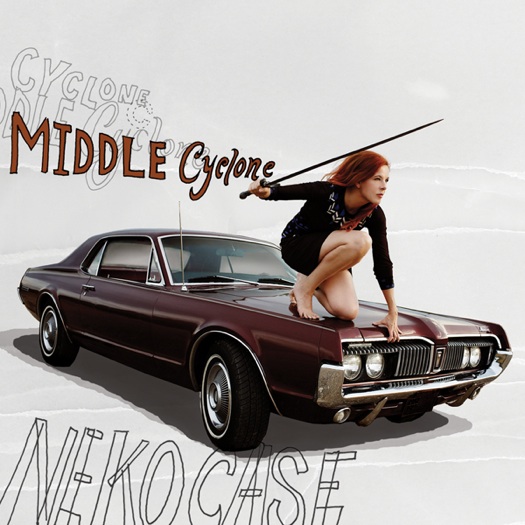
4. Neko Case – Middle Cyclone
It’s no secret that I thoroughly enjoy Neko Case’s singing. So it’s also no surprise that I’m inclined to like her album when it comes out. That doesn’t mean, though, that I’m wrong about this album being completely great. She has one of the most unusual and beautiful love songs of the year with album opener “This Tornado Loves You,” and the entire album has such personality that it’s thoroughly lovely. This album also has the distinction of being co-winner of album cover of the year for me. By now you’ve seen it, right? Neko on the hood of a car wielding a sword. The cover both inspires confidence and sums up the spirit of the album. There’s a sense of love coupled with a fearless fighting spirit for that which is loved. Other strong points on the album include “People Got A Lotta Nerve,” “Middle Cyclone,” and her cover of Harry Nilsson’s “Don’t Forget Me” played with a dozen or so pianos that she got for free from the internet. How can you dislike an album that has that kind of story?

3. Phoenix – Wolfgang Amadeus Phoenix
I don’t remember how, but I came across Phoenix’s previous album,
It’s Never Been Like That a few years ago, and I was surprised that they weren’t bigger than they were. They had solid pop sensibilities, great melody, and catchy beats. Well, now they’ve finally hit the big time with this effort, and I say it’s well deserved. From the opening duo of “Lisztomania” and the ubiquitous “1901” (if you’ve seen a Cadillac commercial this year, you’ve heard it) to the closer “Armistice,” you get even more refined and cleverly textured pop music that is unafraid to be exactly what it is. Even the 2-part “Love Like a Sunset” provides a nice transition from the first half of the album into the second half. This is another group that I’m very happy to see get some recognition for a well crafted album.

2. Camera Obscura – My Maudlin Career
I’ve really enjoyed Camera Obscura’s music, even dating back to when they basically sounded like Belle and Sebastian. Let’s Get Out Of This Country is a strong candidate for my favorites of the decade list. This album picks up where the previous one left off, and while it may not reach all the highs that one did, it’s got some of the most memorable moments for me this year. “French Navy” starts off the album innocently explaining the freshness of a new love, and then it transitions into “The Sweetest Thing,” which contains hands-down my favorite line of the year: “when you’re lucid, you’re the sweetest thing.” “Swans” is a peppy little number sure to get toes tapping. “James” is a sad breakup song that connotes the frailty of love. The title track is another solid song that has a nice disconnect between the somber lyrics and the upbeat music. Final track “Honey In the Sun” would be the best way for Camera Obscura to close an album if they hadn’t already done “Razzle Dazzle Rose” on the previous album. Each has a different tack: “Razzle” is kind of a dissolve ending that just melts away; “Honey” packs one final punch and sticks in your head all day. Great album. It makes me curious to see where they’re gonna go next.

1. Dirty Projectors – Bitte Orca
Dirty Projectors are another one of those bands who weren’t really on my radar much until this album. Like my previous two albums of the year, this one’s a grower. Bitte Orca might be more of a grower than earlier albums, but the payoff is as great if not more so. Each time I listen to this album, I find more and more that was packed into the songs, from additional instrumentation to the quirky but stunning vocal arrangements that frequently pop up out of nowhere just to give the song extra punch. Opening track “Cannibal Resource” is one of those songs that feels a little off the first couple listens, and then one time it just clicks! The opening guitar riff, the seemingly random falsetto notes from lead singer Dave Longstreth, and the backup vocal gymnastics from Amber Coffman and Angel Deradoorian all come together in such a mesmerizing way that it’s difficult not to appreciate the intricate thought that went into writing and arranging this song. And that’s just the first track! Each track has something like that. Some combination of instrumentation, singing, and songwriting just works both within the song and in the album as a whole entity. The beauty of the whole project for me is that I wasn’t really expecting many (if any) of the twists and turns that the album provides, from non-traditional time signatures to chord arrangements to uncommon harmonies. But it all works so well that I have to give the band credit. One wouldn’t think that a collection of nine songs could be as ambitious as these are, but the ambition is both palpable and rewarding. Other strengths (even though there certainly aren’t weak moments) include “Stillness Is The Move,” “Two Doves,” and “No Intention.” I went back and forth on whether I thought this was the best album of the year, and ultimately, I decided that the sheer ambition of this record combined with the talent required to put it together pushed it in their direction. Amazing record, and shame on you if you don’t have it.

There you go! Thanks for reading this far. Have a great holiday season and happy new year!

Wednesday, December 16, 2009

Top Albums of 2009: Honorable Mention Edition

As I said before, it's been a great year in music. This has led not only to a large number of albums on my favorites list but also complicates organizing the list. That said, I think I have settled on my top 30. The albums below are just under that cut. They aren't in a particular order necessarily, and they didn't make the cut for different reasons. Some were nice but didn't wow me as much as the top 30. Some I just recently acquired, so I haven't had enough time to listen to them enough to really get them. So, here they are.

The Avett Brothers – I and Love and You
Venice is Sinking - AZAR
The Crayon Fields – All the Pleasures of the World
Regina Spektor – Far
Andrew Bird – Noble Beast
Maria Taylor – Ladyluck
Dinosaur Jr. – Farm
The Clientele – Bonfires on the Heath
Brendan Benson – My Old, Familiar Friend
Antony and the Johnsons – The Crying Light
Au Revoir Simone – Still Night, Still Light
The Bird and The Bee – Ray Guns Are Not Just the Future
fun. – Aim and Ignite
Headlights – Wildlife
Jonsi & Alex – Riceboy Sleeps
Mono – Hymn to the Immortal World
Metric – Fantasies
The Raveonettes – In And Out Of Control
The Twilight Sad – Forget the Night Ahead
A.C. Newman – Get Guilty

Later this week (hopefully), the proper list.

Tuesday, December 15, 2009

Top Songs of 2009

It's been forever since I've posted something. It might have to do with the project that was the subject of the last post. Well, I have finished my 2nd of 3 case study chapters, and to reward myself, I'm going to go through my annual favorite songs and albums of the year lists. This year, I will add a faves of the aughts list since that's so fashionable right now. I'm working on the albums lists, but for now I shall list favorite songs of the year.

Let me start off by saying that this has been an incredible year in music. I've been pleasantly surprised at both the number of albums released by bands I like a lot and albums by new or heretofore undiscovered groups that have caught my attention. There have also been really solid albums by bands whose previous work I liked well enough but wasn't too crazy about. Overall, I've just really enjoyed the quality and diversity of music that's come across my radar screen this year. So, without further ado, here are some of my favorite songs of the year, in no particular order.

Animal Collective – “My Girls”
Camera Obscura – “Honey In the Sun”
Camera Obscura – “French Navy”
Neko Case – “This Tornado Loves You”
Neko Case – “People Got a Lotta Nerve”
Phoenix – “1901”
Yeah Yeah Yeahs – “Heads Will Roll”
Passion Pit – “Sleepyhead” (this one might be cheating since it came out in ’08)
Dirty Projectors – “No Intention”
Delorean – “Seasun”
Grizzly Bear – “Two Weeks”
The xx – “Crystallized”
JJ – “Ecstasy”
Viva Voce – “Devotion”
Maria Taylor – “Cartoons and Forever Plans”
Regina Spektor – “Eet”
Metric – “Gimme Sympathy”
The Twilight Sad – “Reflection of the Television”
The Bird and the Bee – “Fanfare”
The Appleseed Cast – “As the Little Things Go”
The Antlers – “Two”
The Pains of Being Pure At Heart – “Young Adult Friction”
The Raveonettes – “Boys Who Rape (Should All Be Destroyed)”
A.C. Newman – “The Heartbreak Rides”
Burning Hearts – “I Lost My Colour Vision”
We Were Promised Jetpacks – “This Is My House, This Is My Home”
Andrew Bird – “Anonaminal”
Yeasayer – “Tightrope”
The Decemberists – “Sleepless”
Feist and Ben Gibbard – “Train Song”
The Mountain Goats – “Genesis 3:23”
Ingrid Michaelson – “Soldier”
Dodos – “Fables”

I didn't want to have too many repeat artists. Needless to say if you see the same artist on favorite song and album lists, I like other stuff on the album as well. Coming soon: favorite albums of '09: honorable mention edition.

Friday, August 07, 2009

My life for the next year

I have finally finished my dissertation prospectus, and I'm going to try a little experiment: posting some of it here. I've mentioned my project in at least one other post, so I thought that it might make sense to put some of it here. Ultimately, though, I'm doing this for a couple reasons. First, it feels like a monumental achievement (even though I know that the hard work is really ahead of me now), and I want to show it off. Second, I'm happy to hear comments, suggestions, etc. that might help make it better. In the interest of not overwhelming anyone, I'm going to leave out my literature review and just put in the stuff that outlines what my project will be. Enjoy!

____________________________________________

A Brave New Economy: Rhetoric, Identity, Privilege, and Economic Citizenship in the 21st Century

On September 14, 2008, Lehman Brothers, one of the largest investment banks in the United States closed its doors and filed the largest bankruptcy in the country’s history ($613 billion in debt at the time of the filing). The same day Merrill Lynch, another large investment, bank, announced that it was being purchased by Bank of America. While the economy had been slowing down for all of 2008 prior to the collapse of Lehman Brothers, this unfortunate event became the most visible touchstone for a sharp, sudden downturn in the American economy, which in turn resonated through other economies around the world. This downturn has been referred to as the biggest since the Great Depression. The U.S. Department of Labor reports that “Over the past 12 months, the number of unemployed persons has grown by about 5.3 million, and the unemployment rate has risen by 3.4 percentage points. Half of the increase in both the number of unemployed and the unemployment rate occurred in the last 4 months.”[i]
Since then, the Federal Government has stepped in with a few substantial programs to address the financial crisis that has erupted since September 2008. On October 3, 2008, George W. Bush signed into law the Emergency Economic Stabilization Act of 2008, which established the Troubled Assets Relief Program, among other things. This program enabled the Secretary of the Treasury to use $700 billion to purchase or insure troubled assets owned by financial institutions that they could not get rid of or sell on their own because they would result in a huge loss for the companies and worsen the economic crisis. Measures authorized by this program included bailout money to some of the country’s largest investment banks, major American auto manufacturing companies, insurance companies, and mortgage brokers. On February 17, 2009, President Barack Obama signed into law the American Recovery and Reinvestment Act of 2009, which instituted a number of measures designed to stem the tide of economic decline. Among the measures included were tax cuts, expansion of unemployment benefits and other social welfare provisions, as well as domestic spending in education, health care, infrastructure, and energy. On June 1, 2009, President Barack Obama announced the bankruptcy and structured reorganization of General Motors, the nation’s largest auto manufacturer. The agreement resulted in the federal government taking a 60% ownership stake in General Motors. These events have shaken Americans’ perception of its economy to its core. As a result, the sudden and strong economic recession combined with numerous rounds of bailouts instigated a moment of reflection among individuals and groups throughout the country. Specifically, this cultural moment has opened a space to examine the way that identities are constantly made and remade. The identity of the CEO, the hourly worker, the union member, the consumer, the producer, and even the citizen are in question after the destabilization of the American economy in 2008. These identities are not just a matter of introspection but are always manifested in relationships that involve questions of power, status, and privilege.[ii] These questions of identity are both affected by and affect “the articulation of identities, ideologies, consciousness, communities, publics, and cultures.”[iii] The relationship between identity negotiation and questions of privilege and power are, therefore, necessarily rhetorical, since they involve “the mobilization of signs” for that very purpose.[iv]
In my dissertation, I would like to examine the relationship between privilege and identity that have contributed to the (re)definition of economic citizenship in the economic crisis and bailouts. I am interested in understanding how privilege and identity have come to be understood and have affected the way that American people have situated themselves both individually and communally, particularly with relation to the American economic apparatus. This project seeks to engage the following questions thoroughly: how have Americans come to understand themselves in light of the worst American recession since the Great Depression? What kind of economic citizen have discourses regarding both the economic crisis and the Federal Government’s response to it produced? How has this production happened? What are the conditions of possibility for this rhetorical reorientation of social relations in relation to the economic bailouts of late 2008 and 2009? How has our understanding of privilege shifted in light of these new circumstances, and how has this shift affected identity formation and negotiation on both individual and communal levels?
I argue that the rhetorical articulation of the bailouts in the United States at this time produces an economic citizen with an enhanced sense of personal responsibility to engage the economy in new ways. Overall, though, these discourses become configurations of a larger populist narrative that emerges around this time that has two prominent strains: one pits “the people” against Wall Street investors and CEOs who, from this perspective are primarily to blame for causing the crisis; the other sets “the people” in opposition to the Federal Government and finds fault with its response to the economic crisis. These two strands of populism presume a negative sense of privilege in its characterization of “elites,” a more positive sense of privilege in its positive view of “the people” in the United States, and various points along this continuum. “The people” presume the right to speak out against the injustices they see. They also demand accountability from the ones they hold responsible for the economic crisis, and they seek new ways of engaging with the broader economic landscape throughout the United States. This engagement takes numerous forms, and some of those forms will be examined as case studies in the chapters of this dissertation.

Case Studies
This project’s first two case studies will examine public rhetoric surrounding the to major types of bailouts effected in late 2008 and 2009: bank and auto bailouts (messages of economic bailouts that were widely public, not technical or esoteric discourses involving economic theory). These two case studies should exist in a dialogue with each other to outline similarities and discontinuities between bailouts of banks and automotive industries. The first case study will examine the rhetoric related to the bailouts of the banking industry in late 2008. I will investigate the way that these bailouts were discussed in popular discourses, focusing on issues related to the bailout including questions of fairness and responsibility in company and CEO practices. Specifically, this case study will examine speeches by members of Congress and President Bush around the time of the passage of the bank bailout bill, the public scrutiny surrounding exorbitant practices of companies that received bailout money, the “too big to fail” label given to banks to justify the government bailout of banks, and the testimony that bank CEOs gave to Congressional committees about the use of bailout money. This chapter will also investigate the practice of publicly calling the Chief Executive Officers of the companies involved in the bailouts to testify publicly before Congress. Such testimony concerned questions of both the extent of the companies’ need for federal assistance as well as the individual consumptive habits of the companies’ highest ranking employees (large bonuses, expensive accommodations, etc.). The rhetoric in these various discussions centers on questions of individual responsibility for the poor performance of the companies as well as their role in addressing the issues. This chapter will examine the relationship between the testimony and the practices to determine the extent to which the blame for the economic crisis is placed on the CEOs and what that sense of blame produces both in terms of public discourse and in terms of understood standards of practice for individuals and corporations. The discourse that singles out selfish CEOs who indulge themselves with lavish homes, offices, and modes of transportation can shed light on current modes of populism that have arisen in reaction to the recent economic downturn.
The second case study will focus on the rhetoric surrounding the bailouts of the automotive industry. It will specifically examine the institutional and bureaucratic differences between the auto and bank bailouts, the testimony auto company CEOs had to give in from of Congressional committees regarding their personal actions, the additional issues that presented themselves when discussing auto bailouts (unions, plan for restructuring, necessary sacrifices), and the theoretical distinctions between bank and auto bailouts (e.g. the rhetorical implications of “wall street” vs. “main street”). Auto bailout rhetoric presents another perspective from which to examine the new sense in which economic citizenship is undergoing a transition in the current economic moment. Questions of identity as in economic class (both in terms of income and in terms of type of profession, such as white collar vs. blue collar employment), location (in terms of both geographic location of the country and rural vs. urban locations), and education present themselves in relation to privilege. Populism takes on additional components as we look at the rhetorical effect of automotive bailouts.
Third, this project will continue investigate the populist resurgence by examining The Daily Show’s critique of CNBC’s reporting on the economy from March 4 to March 12, 2009, which culminated in an extended interview between host Jon Stewart and CNBC personality Jim Cramer. This chapter will also look at popular news media discussions of the exchanges, including segments where Jim Cramer appeared on other programs to discuss Stewart’s critique and commentary on the controversy by other news media shows. The episodes, especially the interview with Jim Cramer, garnered some of the highest ratings for the Daily Show so far in 2009.[v] In the exchange, Stewart takes a quasi-Marxist position, blaming both the CEOs for manipulating the stock markets to the detriment of the general public and CNBC not only for allowing it to happen when they had an opportunity to raise critical questions but also for cheering the CEOs and the financial system that created a situation where the general public suffered from said manipulation. Not only does Stewart point out an abuse of privilege in its most negative sense by the CEOs of the offending companies, he chastises CNBC for abusing their privilege (in the form of access to high ranking officials of these companies) to remain complicit (willingly or unwillingly) in the defrauding of the American economy. The exchanges between The Daily Show and CNBC concern both the role that the dissemination of information plays in the free market and the relationship between flows of signification (as information) and flows of capital. The critique becomes a call for a more engaged media, but there is little beyond that. In this sense of populism, a role for news media institutions becomes clear, and the relationship between a vibrant media and an engaged populace is evident. The only responsibility that Stewart speaks to, however, is that of the media to become something akin to political parrhesiastes (truth-tellers) that Foucault discusses in Fearless Speech.[vi] Stewart’s criticism leaves us with a crucial question, though: what are the conditions of possibility of engaging that truth in a productive manner in the current economic climate? What role can a properly informed citizenry play going forward in such a drastic economic recovery?
Finally, this project will interrogate another form of populism that I outline above by examining the conservative organization of tea parties around the country. These are populist protests that echo the famous Boston Tea Party that took place on December 16, 1773 to protest the American colonies’ status of being taxed without being represented in the British Parliament. The tea parties function in this current climate as a protest against efforts by President Obama and the Congress (controlled by the Democratic Party) to use governmental means (taxpayer money) to address the economic crisis. These protests have been promoted on right wing websites and on Fox News, and many of them have been planned for April 15, 2009, the day by which all Americans that earn an income must submit file their income taxes. This form of populism presumes that while the government has the privilege of controlling the taxpayers’ money, the people have the privilege of their voices to influence the government’s policies in a more libertarian (or fiscally conservative) direction.

Methodology
This project’s methodological approach is, to an extent, implicit in the literature review. Overall, both the method and the approach of this project will focus on the construction of the subject, specifically the economic citizen subject as it relates to the economic crash and subsequent bailouts. The economic discourses that will receive significant attention articulate the citizen’s role in political life: ways that citizenship is understood and practiced, narratives that proscribe new limits and conditions for economic citizenship in the 21st century, and potential implications for citizenship’s construction and negotiation in the new economic landscape. It is under the broader theme of the new economic citizen that concepts like populism, rhetoric, identity, and privilege will operate within this project. These ideas inform the practice of economic citizenship and vice versa. Given the complex and multi-faceted nature of the issues in this project, I believe that a poststructuralist theoretical lens would be most advantageous. Specifically, I believe that Michel Foucault’s discussions of power, discourse, and truth-telling would be extremely useful in interrogating populism.[vii] His work from The Archaeology of Knowledge on discursive formations, statements (enonces), and discourse might be useful for examining the case study involving the tea parties across the United States. The parties involve not only numerous different (and occasionally inconsistent) factions but also paradigms that can both overlap and diverge from one another. The contingent collection of these diverse elements of American politics in the tea parties includes libertarianism, religious fundamentalism, and xenophobia. Foucault’s work will be particularly instructive in figuring out the function of these protests at this particular moment.
Given that Ernesto Laclau and Chantal Mouffe have explicitly written about populism in the context of radical democracy, their discussions of articulation, antagonism, and hegemony will be helpful in discussing the final two case studies in particular, but they might also inform the first two to a lesser extent.[viii] Populism runs through each of this project’s case studies, and the approach of Laclau and Mouffe’s discussions of populism, radical democracy, and articulation provide a useful way of examining the diverse voices and statements that can be found in each case study. In the bailout chapters, for example, the collection of diverse perspectives from governmental, business, and individual voices articulate democracy, economic citizenship, and populism.
Gilles Deleuze’s numerous concepts provide some analytical tools that might push the project in new and exciting directions that may be difficult to see even at this point. His theories and those of Michael Hardt and Antonio Negri have influenced Ron Greene’s work on “communicative labor” and “money/speech” that will be especially useful in discussing case studies involving the act of bringing CEOs to Congress to testify for their actions in light of the substantial financial assistance they have received from the Federal Government. The implications of CEO testimony and the Daily Show interview with Jim Cramer reach both linguistic and non-linguistic levels. Similarly, the rhetorical strength of the tea parties can be found in both the signs and slogans that are present at these parties and in the relative size of different parties, the structural organization of parties themselves, and the relationship between the locality of the gatherings and the national scope of their news coverage (particularly by Fox News). Overall, the case studies themselves are highly complex, and traditional rhetorical approaches alone will not provide the robust theoretical tools necessary to examine them thoroughly. Poststructural approaches offer the richness that will allow for a thorough interrogation of the various ways that economic citizenship and populism have provided a new way of understanding the relationship between privilege and identity.

[i] U.S. Department of Labor, “Employment Situation Summary: March 2009,” United States Department of Labor Bureau of Labor Statistics, April 3, 2009, http://www.bls.gov/news.release/empsit.nr0.htm.
[ii] Broadly speaking, I see privilege occurring when a person or group is able to enjoy a benefit or avoid a hardship that another cannot.
[iii] Kevin DeLuca, “Articulation Theory: A Discursive Grounding for Rhetorical Practice,” Philosophy & Rhetoric 32, no. 4 (October 1999): 346.
[iv] Ibid.
[v] Daniel Frankel, “Cramer boosts 'Daily Show' ratings,” Variety, March 13, 2009, http://www.variety.com/article/VR1118001235.html?categoryid=1236&cs=1.
[vi] Foucault, Fearless Speech.
[vii] Michel Foucault, The Archaeology of Knowledge (New York: Pantheon Books, 1972); Foucault, The History of Sexuality. Volume 1: An Introduction; Michel Foucault, Fearless Speech (Los Angeles, CA: Semiotext(e), 2001) See also Barbara Biesecker, “Michel Foucault and the Question of Rhetoric,” Philosophy & Rhetoric 25, no. 4 (Fall 1992): 351-364; Mark Cousins and Athar Hussain, Michel Foucault (New York: St. Martin's Press, 1984); Gilles Deleuze, Foucault (University of Minnesota Press, 1988)
[viii] Ernesto Laclau and Chantal Mouffe, Hegemony and Socialist Strategy: Towards a Radical Democratic Politics, 2nd ed. (London: Verso, 2001); Laclau, Politics and Ideology in Marxist Theory; Laclau, On Populist Reason; Laclau, “Populism: What's in a Name?”; Mouffe, “The 'End of Politics' and the Challenge of Right-Wing Populism”; Chantal Mouffe, The Democratic Paradox (New York: Verso, 2000); Chantal Mouffe, The Return of the Political (London: Verso, 1993).

Wednesday, June 03, 2009

When you're lucid you're the sweetest thing

Now we turn to this year's music, and I have to say that so far, I've been quite impressed with the large amount of good music that's come out so far. We're just under halfway through, and I have a number of year-end list contenders. I don't know if there has emerged a clear frontrunner for album of the year just yet, but I'm enjoying the trial and error. The following albums are ones that I've found myself listening to over and over, ones that I'm still in the process of engaging and appreciating more deeply with each listen (in no particular order). I'll try to offer at least a little preliminary commentary on them.

Camera Obscura - My Maudlin Career
Highly recommended for fans of Belle and Sebastian or just well crafted and shy twee pop. They deepen their sound even more than on Let's Get Out of This Country, which is a good thing. The songs are warm and engaging, and the album fits well into a number of moods. Not much else to say other than a great album that grows nicely. Side note: Erin and I will be going to see them in Atlanta June 19th. Anyone who wants to meet us there is certainly welcome.

Neko Case - Middle Cyclone
Was there any doubt that this record was going to be good? Of course, Neko has brought out a solid collection of songs that are layered not only with careful crafting but carried on the strength of her amazing voice. While I think I liked Fox Confessor Brings the Flood a little more than this one, her current effort is by no means a slouch. "This Tornado Loves You" and "Some People Got A Lotta Nerve" are my two favorites. I've given this one some time off and plan on heading back to it in a little while to see if I think it can surpass her previous masterpiece, but it's really hard to dislike her work.

The Appleseed Cast - Sagarmatha
I've liked The Appleseed Cast for years, dating back to their time on Deep Elm Records. They were certainly part of my emo phase, but they didn't fit the traditional emo mold (more like post-rock, I guess). That's probably why I liked them so much. They were more about cogent melodies than about high-pitched singing about heartbreaks (btw, the Low Level Owl albums are amazing). This album straddles the line between instrumental and subtle singing post-rock, and does it better than they've done so far. Really great effort from these guys.

Burning Hearts - Aboa Sleeping
This album feels kinda like a more organic version of Stereolab, and it's really quite a wonderful collection of tunes. This album is bold enough to be confident in stylistic and substantive choices, yet unassuming enough that it trusts you to engage it on your terms. It doesn't force you to bend to its will, and I respect that a lot. (h/t Heartache With Hard Work)

The Pains of Being Pure at Heart - The Pains of Being Pure at Heart
I really enjoy this band's mix of fuzzy pop with the retro -- late 80s/early 90s -- indie pop. They recall numerous bands in various places, yet the record still feels current in 2009. It's a great record for head bopping or toe tapping, and the melodies can easily get stuck in your head. It's really nice that the songs don't take themselves too seriously and that they still come across with a solid authenticity that is very reassuring.

Various Artists - Dark Was the Night
Of course, this record is going somewhere in everybody's year end lists, right? I mean, it's a collection of the current who's who of indie music, from Arcade Fire to the New Pornographers to the National to Bon Iver. Add to that the fact that pretty much every act contributes a memorable, standout song, and you've got no reason to pass this album up. Plus, it's for a good cause.

Balmorhea - All is Wild, All is Silent
Another great instrumental album from Balmorhea. This one has a little more musical variety in it than the previous effort, yet the increased expansiveness doesn't feel like overkill. The additional instruments give it a broader feel, and again, it's good writing music.

Metric - Fantasies
Metric's new album is so bittersweet for me. On the one hand, the songs are really catchy, and it's clear that the band pays attention to the success of their performance. The main drawback to the album is that it's dreadfully overproduced. It of course brings a clean sound to the music, but at times it feels too clean and too precise. This flaw isn't enough to make me dislike the album, but it does tend to get in the way of a more complete engagement with the songs and the record as a whole.

Passion Pit - Manners
I was initially very wary of Passion Pit, having dismissed them as just another band from NYC doing the "indie dance music" thing that seems to be in right now (Hot Chip, Gang Gang Dance, MGMT, etc.), but this album really impressed me. Their pop sensibility and playfulness shines through, and they don't just get caught up into doing expiremental techno stuff and trying to sound uber-hip. They fuse the keyboards with guitars and more traditional pop sounds quite well. I gotta say, they converted me.

Maria Taylor - Ladyluck
Great female singer-songwriter who was formerly a member of the indie duo Azure Ray. This stuff is more coffeehouse and straightforward than the stuff she did in Azure Ray, and that gives the music a genuineness that is endearing. I predict that "Cartoons and Forever Plans" will make its way to a commercial before year's end.

The Bird and the Bee - Ray Guns Are Not Just the Future
Low key trip hop inspired dance pop. My favorite song here is "My Love." The album makes me think of Imogen Heap's solo work and stuff with Frou Frou. Very catchy stuff that is very easy to enjoy without thinking about too deeply.

Animal Collective - Merriweather Post Pavilion
I know, I know...everybody and their friends will put this one on their list for sure. It's being treated as the greatest musical creation since Beethoven or something. While I usually see Animal Collective as very hit or miss, I must admit that I do really like this album. Finally, they put out a record that is much more accessible than anything they've done before, in my opinion. They tend to melodies and creating layers of music much more and better here than the previous albums which to me seemed much more interested in experimenting for its own sake (and gets pointless real quickly). "My Girls" is easily my favorite song from them.

This is a good start. I have other albums that I think it's too early to say anything about like the following:
Antony and the Johnsons - The Crying Light (1st impression: great in places)
Viva Voce - Rose City (longtime fan of them, 1st listen of this record shows much promise)
Bon Iver - Blood Bank EP (good continuation of previous work)
Mono - Hymn to the Immortal Wind (too soon to tell if it's better than just good)

I'm also looking forward to other albums that I haven't had much/any chance to try out. I'm interested in the Dirty Projectors' new record (previewed it through NPR...not sure what I think about it). I am really excited about Phoenix's new album (probably will have to buy the CD at Target, since it's not on emusic...grr). I'm both intrigued and a little unsure about the new Grizzly Bear record. They're one of those bands that gets high marks from indie critics, but I just don't get them (Animal Collective was like that until their recent album). I like "Two Weeks," so I'm willing to give Veckatimest a try (if emusic ever decides to make it available).

If you've actually read this far, thanks! Also, I'm happy to hear suggestions for '09 records. What have you heard this year that impresses you? What/who should I be checking out?

UPDATE: I don't know how I forgot this one.
Yeah Yeah Yeahs - It's Blitz
Great new album from YYYs. This album is more subtle than their previous work and with more synthesizers than before. It's a more mature approach, yet the album still has a good amount of fun to it. It's definitely worth the time investment to let it grow. I'm still getting more familiar with it with each lesson.

Did you hear the old gospel choir?

Now that summer is in full swing, hopefully I'll be able to post more, both about some more desert island disc picks and maybe some reviews of music that I have found so far this year. I'll start with two things: 1) 2008 albums I missed in my year end list and 2) early favorites of 2009.

On #1:
I became a late comer to a few albums that I subsequently came to appreciate a lot. First, The Gaslight Anthem's record The '59 Sound is a great album, especially if you like the Boss, the Killers, and some straightforward rock n' roll. Another is Balmorhea's Rivers Arms, which is instrumental, neo-classical music that I find wonderful music to play when writing. The following get a solid honorable mention:
Army Navy - Army Navy
The Clientele - That Night, A Forest Grew EP
Dr. Dog - Fate
Marching Band - Spark Large
Mogwai - The Hawk is Howling
Rosebuds - Life Like
She & Him - Volume One
Titus Andronicus - The Airing of Grievances
Tobacco - Fucked Up Friends
Gang Gang Dance - Saint Dymphna

Next post: Number 2

Thursday, April 16, 2009

Teabagging Everyone in America

I've briefly mentioned my dissertation above. Another chapter I'm considering deals with the tea(bagger) protests that were much discussed and occurred yesterday across the US. As part of (I guess you could call it) quasi-ethnographic research, I attended the Atlanta tea(bag) party and took some pictures. I got there around 6:45 and just walked around. The crowd was pretty big (I'm terrible at numbers, but if I had to guess, I'd say maybe 5,000). It was at the State Capitol. There was a big stage where speaker after speaker went up and spoke their peace about how we're overtaxed and spending our children's future. There were also two big screens showing the people on stage (which seems a little expensive and intricate for an "entirely organic, grassroots" sort of thing, but maybe these grassroots must have a lot of money). I didn't join in any of the protesting or cheering when speakers made their fairly standard points. One speaker mentioned the three goals of the movement: property rights, lower taxes, and a Christian nation. Other than that, it was difficult to see the basic point of the protests other than to complain about the current administration. I come to this conclusion despite the idea that some of the protesters voiced to me that this was about implementing the so-called Fair Tax (and there were plenty of signs for that). Below I have a slideshow of pictures I took at the event. I tried mostly to get signs, and I noticed a few patterns in the rhetoric emerging as I was there. I'm not entirely sure what I think about this, but I feel like there is something interesting that I can say with the help of some of the folks I've been reading this semester. This protest seems like an attempt to constitute a certain type of economic citizen whose relationship to the government is minimal in the hopes that the unfettered free market will magically flourish and help everyone in the country (or at least everyone who matters).

This also feels like an entirely unoriginal hodgepodge of right-wing slogans and talking points with almost no sense of 1) what their sense of the world should look like (other than replace the income tax with the unconstitutional national sales tax)...in other words, it's just a negative reaction to the status quo; or 2) how to bring about that change other than through supporting conservatives running for office.

I think that part of the issue is that you have your standard, run-of-the-mill conservatives protesting against Obama and the "liberal" (scare quotes are, of course, intentional) policies Washington is putting in place to respond to the extraordinary economic crisis protesing alongside the more extreme (dare I say fringe?) elements of our political culture, calling for scrapping the income tax and replacing it with a national sales tax
(which would require a Constitutional Amendment to repeal another Constitutional Amendment) and abolishing the Federal Reserve. I even saw a rebel flag at this event, which could suggest, among other things, an openness to secession. As Rachel Maddow so correctly points out, tax day protests have been done inthe past. The difference this year seems to be the way that the Republican party has decided to co-opt this tradition in the hopes that it can reconstitute the GOP into a viable political force in the years to come. The problem seems to be, though, less that they are "astroturf" as opposed to "grassroots" as much as the fact that they're using these old arguments to deal with an economic environment that doesn't fit this perspective. That disconnect is what's so interesting to me, and I'm wondering both what the conditions of possibility are for the reactions to the crisis and the conditions of possibility for the drive to incorporate these protests into a larger political movement.


Tuesday, March 17, 2009

The Daily Show v. CNBC and Jim Cramer

I know I'm a little late in posting on this, but I'm intrigued by this whole exchange (including both the Daily Show critique pieces and the interview) between Jon Stewart and Jim Cramer on the Daily Show. My dissertation is going to be a rhetorical examination of the economic meltdown and bailout through the prisms of privilege and identity (What does the economic crisis do to what we think of as privilege? Who is privileged now? How do we discuss the privileged and privilege itself? How do identities get constructed and negotiated in a major economic crisis such as this?). Part of this deals with questions of blame, but I'm also interested in the way that rhetorical responses have materially impacted various flows (capital, for one), both in terms of signification and other forms of articulation. After seeing the smackdown of Jim Cramer, I'm seriously considering doing a chapter on the Daily Show vs. Cramer exchange because I think that it hits on crucial questions of identity and privilege that I'm looking into here. In this spirit, I'm posting the unedited interview Jim Cramer gave on the Daily Show where Stewart takes Cramer to task for embodying the worst aspects of CNBC's reporting. What do you think? Does this idea make sense for a study of rhetorics of privilege as they relate to the economic crash/bailout?


Friday, February 06, 2009

Rachel Maddow makes my day

After seeing Paul Krugman go on MSNBC's Morning Joe and put the beatdown on GOP talking points about this recent stimulus business, leave it to Rachel Maddow to bring it on home. She is such a vital part of our public discourse, and her insight is so keen, efficient, and just plain awesome. Thank you Rachel Maddow. Thank you!

Here's what I'm talking about:


Monday, January 26, 2009

In which I ponder my home state

The above picture is of my former bumper sticker. I had placed it on my car in September and displayed it proudly until today, when I noticed what you see. I had been gone at a debate tournament all week, and before I left, I am certain this had not been done. Some annoying little prick decided to 1) deface my personal bumper sticker and 2) use the mack daddy racial slur to do it. As hurtful of a gesture as this move is supposed to be, I was more struck by how pathetic it was than I was offended. Of course, I was (and still am) offended, but I don't want the asshole who did this to get the satisfaction of getting to me. Instead, I choose to see this as a truly pathetic cry for attention without the maturity of taking any responsibility for his discourse (I say "his" because I figure that the handwriting and passive-aggressive undertones indicate a male culprit...although I reserve final judgment on the sex of said individual). Words cannot express how petty, infantile, and simple this act is. I have a hunch that it is someone who lives near my residence, but I have no way of knowing for sure.

This incident is telling given that I'm currently teaching a Rhetoric and Privilege course. There's a lot involved in this that relates to privilege. The perp tapped into classic racial privilege in using the word as a weapon not only against Obama but (indirectly, of course) against me as well for displaying a bumper sticker of support for the President. I mean, think about it; would we feel the same way about a Bush/Cheney sticker with the word "Cracker" written on it? Additionally, my reaction is possible because of types of race privilege that I experience. I have never had a friend or family member called that in my presence. I have no history with the word. My knowledge of it is mostly intellectual in nature. Seeing the word on my car, though, brought it into my life in a way I'd never experienced before, which is a privilege. I find myself a little taken aback at the boldness of racism in the year 2009, even though I do live in Georgia. I just can't help but wonder why my bumper sticker was such a threat to the culprit that he found a marker, took the time to alk over to my car, bend over, and scrawl that? Is there really nothing better he could do with the minute or so that he used to deface my bumper sticker?

Obviously, I took the sticker off my car, but I replaced it with another Obama/Biden sticker I had. I'm not gonna give this asshole the satisfaction of winning that easily. Plus, I have proof that he's a grade A dumbass. Later tonight, I found out that he defaced another of my bumper stickers.
Can you spot the error? Initially, I had thought that maybe culprit was going for some sort of Derridean erasure maneuver on the word "is," but I don't want to give that dipshit any such credit. My guess is the idiot was trying to scribble out the "NOT" and was too dumb to pull that off. Interestingly enough, he could spell the slur correctly. Why is that word so easy for racists to spell correctly but not a word like "official"?

Saturday, January 17, 2009

New Neko Case!


OK, now it's time to look forward to the new year in music. In that respect, I'm totally looking forward to the new Neko Case album! It's called "Middle Cyclone," and if the first single is any indication, this record may land on numerous year end lists. The song is "People Got a Lotta Nerve," and Case's label Anti- has an interesting proposal for publicity: they'll donate $5 to Best Friends Animal Society for every blog post about the new song. Not only does it bring attention to the song but it highlights a good cause as well. And the song itself is quite nice. Not only does it showcase a nice up tempo pop-country vibe that is one of her trademarks but it has an interesting take on people's perceptions of human (and animal) nature.

Neko Case - "People Got a Lotta Nerve"

PS...how badass is that album cover?
PPS...Neko Case is in competition for best female singing voice in all of music. If you have a chance to hear her live, you should take it.

Thursday, December 18, 2008

My Top 30 Albums of 2008

I am such a fan of "favorite things of this year" lists, especially albums. It's so fun to compare notes with other people, groups, organizations and see what was notable to whom for what reasons. Sometimes it's validation (or not) of my view of songs/albums, and other times it becomes a way for me to find out about records that may have avoided my radar. Last year, I added a youtube video of a song from albums, and it felt like the post took forever to load. Needless to say, I will forgo that this year. Like I said on the "favorite songs" post, if you're interested in learning more, search the internet, youtube, google, myspace, Hype Machine, etc.

30. The Dodos – Visiter
While this album is kind of hit or miss for me, the hits definitely outweigh the misses. Pitchfork has compared them to a more unplugged version of Animal Collective, and to some extent, I can see that. It’s stripped down music, but there’s a lot of heart to it, from the energetic drumming to the driving acoustic guitars to the occasional supplemental shout. Strengths include “Red and Purple,” “Fools,” and “Jody,” and while I can live without some other tracks, their unconventional quirkiness isn’t enough to take away from the album’s successes.

29. The Notwist – The Devil, You + Me
This album is a soothing, yet odd little collection. It occasionally goes off-kilter (complete with Radiohead from Kid A-style percussion), but it comes back with a soft landing. You then realize that you’re better for the journey. There’s still a smoothness and subtlety to the execution here that’s heartwarming. The occasional gentle strum of the acoustic guitar with the soft but driving rhythm section give their music warm undertones that make it an enjoyable listen. Favorites include “Good Lies,” “The Devil, You + Me,” and album closer “Gone Gone Gone,” which sounds like a song you could hear playing during the credits of either The Office or an indie film. It provides an appropriate anticlimactic end to either a short story or an album built on subtlety.

28. Death Cab for Cutie – Narrow Stairs
Another very enjoyable record for Death Cab for Cutie, although it’s clear that they are taking some chances with this record. Its more unconventional song structures mix with the band’s knack for solid pop songs for a record that is a pleasant listen. Songs like “Cath…” and “No Sunlight” are really catchy, and despite the lyrics, they bring out a sense of optimism that is infectious. I do wonder, however, what’s up with the 4 minute intro to “I Will Possess Your Heart.” Overall, though, Death Cab has another catchy, smart record that grows well with a few listens.

27. Earlimart – Hymn and Her
If you were ever in the mood for some more Elliot Smith-esque pop, may I introduce Earlimart to you. In songs like “God Loves You the Best” and “Cigarettes and Kerosene” I swear the male singer Aaron Espinoza sounds just like Elliot. Other times you get some pretty good moody pop music. They have a great combination of instruments, and the songs from female vocalist Ariana Murray (“Time for Yourself,” “Before It Gets Better”) bring a nice balance to the record. It’s got a good range to it.

26. Bon Iver – For Emma, Forever Ago
The softness and intimacy of this album is quite striking. This album has gotten a good bit of attention around the blogosphere for good reason. With little more than a guitar and the occasional percussion, Bon Iver have managed to capture emotional connection and vulnerability in a way unlike any other. I can appreciate the sentiment, even if the songs don’t stick in my mind as long as others on the list. My favorites are “Skinny Love,” “Flume,” and “Blindsided.”

25. Los Campesinos! – Hold On Now, Youngster/ We Are Beautiful, We Are Doomed
I am a late comer to Welsh band Los Campesinos!, so with some more time, it’s possible that these two albums (they released both albums this year) could have moved higher with some more time in my sights. In my few short listens, however, I have been very impressed with the combination of energy and pop crafting that has gone into both albums. The guy/girl lead singer trade-off makes for a good dynamic, and their playfulness only adds to the fun in hearing them. I couldn’t decide between the albums, so both are listed here. “Hold On…” has more energy and rawness, while “We Are Beautiful…” is a little (just a little) more subdued and focused. They don’t just follow the pop formula, though. They add something to it. Case in point: “I cherish with fondness the day (before) I met you.” The addition changes the sentiment and opens it up to new perspectives. Other strong points include “You! Me! Dancing!” “Ways To Make It Through The Wall,” Miserablia,” and “Sweet Dreams, Sweet Cheeks.”

24. Grand Archives – Grand Archives
The demise of Seattle favorite Carissa’s Wierd led to the creation of Band of Horses, who have put out two solid albums. After their first album (the better one, IMHO), guitarist Mat Brooke (who had also been in Carissa’s Wierd) left the band to start Grand Archives. The result is a pretty good album of familiar melodies that are just done well. It doesn’t stand out as a heartbreaking, mind-blowing experience, but that’s part of the appeal for me. It’s just a nice, straightforward album with the occasional whistle, harmonica, and well executed melody. High points for me are “Torn Blue Foam Couch,” “Sleepdriving,” and “A Setting Sun.” It’s a good Sunday afternoon, relax with a good book album.

23. British Sea Power – Do You Like Rock Music?
With an album title like “Do You Like Rock Music?” one would expect the new British Sea Power album to be a broad, sweeping rock n’ roll opus that wears its ambition on its sleeve. While the band doesn’t exactly meet those expectations, they do put together a collection of tunes that manages some atmospheric finesse. It stumbles in a few places, most notably the end song “We Close Our Eyes,” which is just a reprise of the opener “All In It.” The problem, though is that the reprise is almost 4 times longer than the opener and just repeats the ideas in the first. High points, though, kick through with driving melodies and leave such low points in the dust. Recommended tracks include “Down On the Ground,” “Waving Flags,” and “Atom.” The middle half of the album is definitely worth it.

22. Longwave – Secrets are Sinister
This album made an impression on me in its unyielding catchyness. It’s good indie pop that ranges from the crunching guitars and keyboards to quasi-ballad with clean guitars and pretty melodies. All in all, it’s worth a few listens. Sure, the song structure is fairly predictable, and the band kinda blends the styles of bands like Echo and the Bunnymen, Paloalto, and Death Cab for Cutie, but that’s not really a bad thing, right? Sometimes, the way you can combine these influences is a benefit in and of itself. “Sirens in the Deep Sea,” “Satellites,” and the album closing title track inject a little sunny optimism, but not too much.

21. Glasvegas – Glasvegas
I have a special place in my heart for Scottish bands whose lead singers don’t lose their accent when they sing. Glasvegas join the Twilight Sad and Frightened Rabbit in that category. I feel like the accent adds a sense of emotional rawness and vulnerability that gives the music an extra quality. Add in Glasvegas’ anthemic, crunching guitars, and you have a winning combination. They happen to have one of the best tracks of the year in my opinion: “Geraldine.” The song is from the perspective of a social worker trying to keep poor, drug addicts from going off the deep end, and you don’t realize it until about halfway through the song. The turn of phrase just gets you. It’s so memorable and emotional that it alone makes 2008 in music a good year. It’s not the only solid track, though, to be sure. Opener “Flowers and Football Tops,” “Lonesome Swan,” and “S.A.D. Light” are also great songs in their own right. It’s not their fault that they are overshadowed by such an achingly beautiful song.

20. Mates of State – Re-arrange Us
Another soft spot goes to married couples who form a band together. Part of it’s the hopeless romantic in me, and part of it has to do with the fact that many of them make solid music. Along with the Submarines and Viva Voce, we can add Mates of State. While this album isn’t as strong as their previous effort, Get It Back, it’s certainly a very pleasant listen in its own right. On this record, Kori Gardner mostly trades in her Yamaha Electone organ for a piano. The result is a little loss of the edge earlier albums had, but in exchange we get a more sustained focus on crafting good, memorable pop songs. “Get Better” is one of their prettiest songs, and “My Only Offer” doesn’t trail that far behind. All in all, this is a well executed pop record. The only thing I find lacking is some of the umph that was so visible on Get It Back and All Day EP. With a little more intensity, this is a record that could have easily cracked the top ten, but obviously it’s still good enough to make the list.

19. The Week That Was – The Week That Was
Peter Brewis of Field Music took a hiatus from his main project to craft a side project, The Week That Was. Their debut album boasts an expansive reach (with 9 members working together seamlessly) while still retaining a focus that makes the album so darn enjoyable. They pack a lot into only 8 songs (32 minutes), so I don’t feel like I’m being shortchanged. Plus, it’s so easy to listen to this album 3 or 4 times without realizing it. It works in familiar elements with new twists, and the carefully crafted smoothness of songs like “It’s All Gone Quiet” and “The Airport Line” work so well in contrast with the pounding percussion of “Learn to Learn” and the album’s strongest song, “Scratch the Surface.” This is certainly one of those albums that might have been even higher if I had been able to listen to it since April or May. This one needs room to breathe; trust me, it’s worth it.

18. Vampire Weekend – Vampire Weekend
That’s right. The blog darlings of 2008 made it here. The album is just so darn catchy, and they even have a song with my name in it (“One (Blake’s Got A New Face)”). The first couple of listens were the most unsure, but once the tracks sink in, they’re pretty much there for good. My top 3 favorites on the record are “Oxford Comma,” “A-Punk,” and “M79.” There’s just something so fun and laid back about their music. I think senses of escapism and playfulness in both the lyrics and the song structure really help this record grow on you quickly. Plus it benefits from The Week That Was’ knack of crafting a short, good album so that you can put on repeat a few times without getting sick of it. As the songs mature, they add some depth, but they don’t take themselves too seriously. To me that quality is a rare thing. If only more groups could capture some playfulness in their music.

17. MGMT – Oracular Spectacular
Another blogosphere recommended group. This duo has had a great year, including getting the cover of SPIN magazine (November). Their record suggests that they’ve earned it. It’s dramatic psych-rock that somehow manages to sound both retro and futuristic at the same time. Either way, from the opening keyboard riff on first track “Time to Pretend,” you realize that you are somewhere (or when) else. They use a broad range of instruments and sounds, and that keeps the record from falling into a rut or feeling too repetitive. They give off sounds that remind me of Yeasayer’s debut album and even Animal Collective (especially on “Pieces of What”). For me, though, the star of this album is the dynamic keyboard that provides some of the driving melodies that make the record shine. Other favorites for me include “Electric Feel” and “Kids,” a close second for favorite track on the album behind “Time to Pretend.”

16. Tokyo Police Club – Elephant Shell
After such a journey into the unfamiliar, it becomes time to move into more comfortable territory, and for that I turn to Tokyo Police Club. They’re a pretty good indie rock, post-punk-y band whose latest album Elephant Shell delivers that comfort in droves. With almost every song clocking in at under 3 minutes, they deliver the energy and emotional outpouring you expect from the genre without overdoing it or wearing themselves too thin. I don’t have much more to say about this album, mostly because there’s not much new with it. They just do what they do well enough to make for quite satisfying repeat listens. I’m a fan of “Juno,” “Your English is Good,” and “Tessellate” (my favorite).

15. Sigur Ros - með suð í eyrum við spilum endalaust
Sigur Ros has been all about making some excellent ambient music for years now. I’ve enjoyed their music since Ágætis Byrjun, but I was unsure if they would be able to branch out without losing the core of their sound. I was even more unsure when Takk… came out because, even though I liked the album, it felt like it was too much of a departure from what they had done before. This record, though, pretty much puts to rest all those fears. It’s beautiful, but it brings in more pounding, driving percussion from Takk… in a way that doesn’t feel too overpowering. There’s an intensity to this record that I hadn’t gotten from previous records. The beauty of the record overflows, and this becomes one of those albums that can accompany both mellow and content moods. It’s hard to pick favorites for this record, but I really like “Festival,” “Við spilum endalaust,” and closer “All Alright,” which is the first song Jonsi sings in English.

14. The Helio Sequence – Keep Your Eyes Ahead
This record has enough good indie pop sensibility to draw you in closer with every listen. Starting with “Lately,” a song whose narrator is trying to convince himself that he’s over his ex, you begin to understand where singer/guitarist Brandon Summers is coming from. I think it has something to do with a subtle Dylan-esque quality to his vocals. It’s very nice music, but you get the sense of melancholy pervading every note. There’s a sense that the hammer of harsh “reality” is always just beyond our peripheral vision waiting to invade and take out our slowly tarnishing “idealism” (whatever the words in quotation marks even mean). “Can’t Say No” bombards you with the despair of contemporary American lifestyle that compels you to join in even as you want to retreat. It’s a great expression of the cognitive dissonance I’ve been feeling for years every time I go into a mall or Walmart. Other solid tracks include “Shed Your Love,” “You Can Come To Me,” and “Broken Afternoon.”

13. Hello Saferide – More Modern Short Stories from Hello Saferide
This is just a beautiful record. Swedish band Hello Saferide have crafted one solid pop album, no question. Music journalist turned lead singer Annika Norlin has a solid singing voice, and the crafting of songs is just wonderful. She’s able to capture longing and lack so well without being depressing; her wit is something to marvel. There are points in which she tries too hard, and those become noticeable for sure. Overall, though, they don’t really take away from the album’s splendor as much as they serve as a temporary distraction from sentiments you can feel running from start to finish. My favorites are “Lund,” “Middle Class,” and very favorite “Anna,” a hypothetical about a child that the narrator and partner would have had if the partner had not left. The unique perspective Norlin takes throughout this album is both heartbreaking and refreshing at the same time.

12. Ra Ra Riot – The Rhumb Line
The melody of this album is just spellbinding. I guess that’s what happens when you have both a violin and a cello in your band, but still, they manage to use each instrument so well that the music has real heart to it. You can feel it in every note of this record. From album opener “Ghost Under Rocks” to “Dying is Fine” and even in the low point of the album, their cover of Kate Bush’s “Suspended in Gaffa,” you know that the band is 100% committed to the sonic output. This is an indie pop band that wears its heart on its sleeve, and that genuine outpouring only makes the beauty of the album’s well-crafted songs even stronger and more palpable. Lead singer Wes Miles is both a good singer and someone with the knack of giving all he’s got to a song. This album is worth a significant investment of your time, and I would expect this band only to get better in the next few years.

11. Okkervil River – The Stand Ins
The Stand Ins is a sequel (I think) to their excellent previous album The State Names (which made it to #10 last year). Again, this one deals with headaches and pressures of trying to make it in acting as well as the relationship between the star and the audience. While I’m still a slightly bigger fan of The Stage Names, I am quite impressed with the follow-up. They build on the crafting of the previous records (BTW, Black Sheep Boy is also incredible), and Will Sheff’s storytelling is still quite strong. Plus, he’s quite a good singer, the kind you have to hear live. As an aside, I saw Okkervil River and the New Pornographers this past May, and I became convinced that Will Sheff and Neko Case both have voices that must be heard live. In person, they each blow away their respective album performances. This record stands up on its own as it extends on lyrical themes and carves out its own musical niche.

10. The Mountain Goats – Heretic Pride
I got turned onto John Darnielle’s project a couple years ago, but I have since been stunned at his knack for using details to sketch out wonderfully intricate stories, complete with characters’ thoughts and realizations (“This Year,” “Dance Music,” “Woke Up New,” and “No Children” are the top 4 must download tracks from The Mountain Goats). He is an amazing lyricist, able to express emotions better than just about any songwriter I’ve heard. His new album, Heretic Pride, doesn’t have an overarching theme like his last 2 or 3 records have. Each song is its own separate story, but they all still work so well. “Sax Rohmer #1” is probably the high point on the album, but other enjoyable songs include “Autoclave,” “So Desparate,” and “How to Embrace a Swamp Creature.” This album has the benefit of working together as a complete package without a song or two going just far enough astray to make you want to skip it (probably the only shortcoming of his previous records for me).

9. Headlights – Some Racing, Some Stopping
Yay for twee pop! This is one of the best indie pop albums I’ve heard in a while. From the very twee-tastic “Cherry Tulips” to the Camera Obscura-like sounds of “On April 2,” this album delivers unabashedly straightforward gushy pop that is just a joy to listen to. It’s all about soft sounds and ambient guitar and keyboard melodies. The guy/girl lead singer switch-off is also part of the formula for success. The attention to melody and harmony are so enticing that it’s easy to get lost in the album, even though it clocks in at just above 30 minutes. Other standouts for me include “Get Your Head Around It,” and “Market Girl.”

8. M83 – Saturdays = Youth
As a child of the 80s, I can say that this album touches that soft spot of nostalgia that I have for my childhood. It most definitely has the 80s sound, but in a way, it’s also very not 80s. The synthesizers and soft, new wave sounding vocals are definitely a throwback to the decade of the rubik’s cube and Back to the Future, but there’s also something very now about the songs on this album. In other words, I don’t think that the 80s would have been ready for this music. There’s some over the top instrumentation and percussion, but it is always complimented with a sense of calm that I don’t recall from Simple Minds or Modern English. High points are “Graveyard Girl,” “Kim & Jessie,” and “We Own the Sky.” The journey back in time is both awe-inspiring and comforting, especially with the 10-minute wind down “Midnight Souls Still Remain” to close out the record.

7. Deerhunter – Microcastle/Weird Era Cont
I enjoyed Deerhunter’s previous album, Cryptograms, even though I thought there were times when it wandered around in ambient noise for too long. Their latest release is a double album of sorts. Microcastle is the main album, but along with it comes Weird Era Cont, this bonus disc with as many songs as the primary recording. Since they work so well together, I’m keeping them together for the purposes of this ranking. I’ve listened to Microcastle more, but both records hold up well to repeated listens. On both records, Deerhunter stray back into the world of pop music with more discernable melodies and instrument arrangements that make it less work to get acquainted with the songs. Standouts from Microcastle include “Agoraphobia,” “Saved by Old Times,” and one of my favorite songs of the year, “Nothing Ever Happened.” If you hear no other Deerhunter song ever in your life, download this one. It’s the truth, especially the back half of the song where the instruments just take over and finish out the song. “Nothing Ever Happened” becomes the heart of the album, as well as its peak. The rest of the record basically revolves around this high, but there isn’t a disappointing track between 25 songs.

6. Fleet Foxes – Fleet Foxes/Sun Giant EP
Fleet Foxes have had a wonderful year! They’ve gotten tons of recognition, played on practically every late show on television, and put out a debut EP and LP, both of which are wonderful. The harmonies on the record are heavenly, and the band isn’t stingy with them. You have no shortage of lyrics are about the mountains, or open fields, or woodland creatures in the snow. There’s nice imagery, and the music is so wonderfully crafted that it’s difficult not to enjoy both records from start to finish. Sun Giant EP opens the door with songs like “Drops in the River” and “English House” giving you a taste of what to expect on the full length LP. The eponymous album picks up where the EP leaves off and just goes farther out into the wilderness with confidence. High points on the LP include “White Winter Hymnal,” “Ragged Wood,” “He Doesn’t Know Why,” and closer “Oliver James.” Congratulations for Robin Pecknold and the rest of Fleet Foxes on two solid recordings in one great year.

5. Cut Copy – In Ghost Colors
I have been a fan of this album since April, and I mentioned back in May that it was one of my favorites. Things haven’t really changed much since then. I’ve given the record some breathing space, and it keeps coming back to me with enough life and energy to be its own battery. I never cease to be amazed at how Cut Copy can weave their way through various musical genres with relative ease. You start out with indie pop, move to 80s new wave, go to progressive rock, stop off at dance, and back without realizing just where you were going until you’ve gone through it all. The song construction is tight, and the variety blends so seamlessly that it’s really quite a feat that they’ve managed to retain credibility as they put all the songs into one collection. They don’t lose musical integrity as a band no mater where they take you. I still think that “Feel the Love” is one of the best Track 1’s of the year. It’s just bright and shiny without trying too hard to get your attention. Other solid standouts include “Lights and Music,” “So Haunted,” “Hearts on Fire,” and “Strangers in the Wind.” This is one of those albums I put on when I’m in a rut writing and need something to help me get my second wind, and it hasn’t failed me yet.

4. Santogold – Santogold
Oddly enough, I’m even surprised at myself with how high this record is on my list. Maybe sometime later, I’ll rethink things and decide that this wasn’t very bright, but for now, it’s #4. Santi White (aka Santogold) takes the genre-hopping that I just mentioned with Cut Copy and goes about it in a completely different way. Rather than weaving seamlessly from one genre to another, she blatantly jumps from clever indie rock/pop (“L.E.S. Artistes” and my favorite on the record, “Lights Out”) to M.I.A.-style underground dance/R&B (“Creator” and “Unstoppable”) and everywhere in between. The transition is abrupt, but on this record, that seems to be part of the point. Each song has such strength of voice and character that there’s no need for her to justify the broad range of music on this album. Her voice is unique, and it’s actually quite refreshing to see her refuse to be bound by traditional musical genres, incorporating whatever she thinks will give her work something fresh and unique. It’s also amazing how Santogold can put out so many songs that are ridiculously catchy yet still credible enough to avoid being corny. Some of my other favorites include “Say Aha” and “I’m a Lady.”

3. Portishead – Third
Ok, first off, I was not trying to be funny by having Third be my #3 album of the year. It’s a coincidence. I am, though, so excited that Portishead is finally back with another record. As I mentioned in my May post, the hiatus was way too long. It’s so fascinating to see how the 10 year break has influenced Portishead’s song construction. I mean, think about it. The last time Portishead released a new album, Bill Clinton was President. For one, they still have retained the basic sound and somewhat gloomy outlook that became a trademark for their first two records. The shift, however, comes in some bold new innovations. There’s the pulsating Hammond B-3 organ on “We Carry On” that feels like an irregular heartbeat, the ukulele olde timey quasi-song “Deep Water,” and of course, the pounding drums that drive the album’s strongest track (and possibly one of the best songs Portishead has ever done), “Machine Gun.” Beth Gibbons’ voice is as fragile and intimate as ever. They rely less on samples and more on the raw combination of instruments, and somehow that move feels right. After listening to the record a few times, it becomes clear to me that this record could not have been made or released in 2000, 2002, or even 2004. This feels like the right time for Portishead to come out of hiding and make their mark. I hope it doesn’t take another decade for a follow up, but if that’s what it takes for another masterpiece like Third, I would be willing to wait if it came to that.

2. TV on the Radio – Dear Science
TV on the Radio is definitely one of the most innovative and edgy bands out there right now. Their previous record, Return to Cookie Mountain, is probably one of the most difficult albums I own. I got it a couple years ago after it started showing up on so many year-end lists, and for the life of me, I couldn’t figure the record out. I have played it numerous times, let it sit for a while and come back to it, and still I am puzzled by some of it. Part of it for me is that the innovativeness is inseparable from a raw abrasiveness that I can’t quite put my finger on. Well, that trepidation weighed heavily as I listened to Dear Science, and I was both puzzled and blown away at the same time. In one sense, I wondered if this was the same band that gave us such off the wall tracks as “I Was a Lover”? At the same time, though, I knew that this was the same people, but something is very different here. The album has lost that abrasiveness without giving up innovation. It’s much more palatable. The unfamiliar is still engageable in a way that I still haven’t found with Cookie Mountain. This is a much smoother and accessible record than the previous work was, and I am convinced that both the band and I are better for it. The chaos has settled, but it’s not gone. It’s something that feels less scary and presents itself as pure possibility. Of course, some of the songs are about the current political climate and the hope that things will stop sucking soon (“Golden Age”), but they do so without a sense that all is lost. There is a hopefulness and focused energy on this record that makes it so freaking astounding to listen to over and over, even as it ventures into new territory. As with many albums on this list, this one should get a few listens with the headphones so that the music can connect directly with the music and you don’t have to worry about the atmospherics of the room interfering with the subtleties.

1. Frightened Rabbit – The Midnight Organ Fight
To be completely honest, I’m very surprised that this album hasn’t surfaced on more year-end lists than it has. When it has shown up, it’s been more toward the bottom of the list. I do not know what is up with many of the music mainstay organizations. This album not only got good reviews, but it is one of those albums that breaks in nicely. In May, I said that this was my early favorite for album of the year, and while there was a while when I wasn’t sure that would hold up, I can’t deny that this has been my favorite record to listen to all year. I’ll echo the comments I made on Glasvegas’ debut about how I totally heart Scottish bands whose lead singers keep the accent when they sing. Scott Hutchinson has a unique ability to sound both strong and fragile as he sings. There’s also a really great connection between body and state of mind with songs like “The Modern Leper,” “Good Arms vs. Bad Arms,” “Head Rolls Off,” and another one of those pivotal ballads, “Keep Yourself Warm.” Hutchinson’s strength as a songwriter comes in this understanding that emotional and physical connections are inseparable (the central line in “Keep Yourself Warm” is either genius or hackneyed depending on who you ask, “It takes more than fucking someone to keep yourself warm”…I’m less concerned with whether it’s clever and more interested in how it informs the album’s perspective). In fact, the relationship between biological processes/embodied experiences and perceptions/memories/ideas becomes one of the central themes of the album that surfaces in new ways with each song. It touches on the overflowing emotional journey that comes with life, relationships, and human interaction that becomes filtered through an existence in a body that is fragile, vulnerable, and always already limited. All in all, this record is very human. It has ups and downs, surprises and disappointments, successes and frustrations. The Hutchinson brothers are able to articulate parts of that complexity through the complex relationship between music and words, and the listener is better for the engagement. At first, the realization of how vulnerable we really are as a people can be disconcerting to say the least, but the more I got into this album, I started to understand that this vulnerability doesn’t have to be a weakness. It can be strength because once you understand its parameters and learn to live your vulnerability, you don’t have to give in to despair. The determination in “Floating in the Forth” with the line “I think I’ll save suicide for another year” (probably the best line of the album) gives me a reason to look forward, not with hope that things will get better, but rather with the understanding that the uncertainty of tomorrow or next year can be as inspiring as it is debilitating. Ultimately, it’s worth it to see what the unknown could bring.

If you actually made it this far, thank you very much for reading and Happy Holidays!

UPDATE: I forgot to mention that Frightened Rabbit have put out a live album where they basically play The Midnight Organ Fight in order. It's called Liver! Lung! FR! It's cool to hear how the songs translate in a live, but intimate setting.